The content marketing world has officially crossed the line from “AI as a handy sidekick” to “AI as the core engine of modern SEO.” What started as simple keyword helpers and drafting tools turned into full‑blown AI‑native strategies once interfaces like Google’s AI Overviews and ChatGPT began dominating user queries.
As those AI answers took center stage, organic clicks dropped to around 40%. Yes, 60% of queries end with no clicks, yet the brands actually cited in AI answers see conversions climb.
By 2025 and 2026, the shift accelerated even faster as agentic AI workflows automated entire content processes, pushing marketers to prioritize AI Experience Optimization over old‑school keyword rankings just to stay visible in a zero‑click world.
Let’s walk through what an SEO content strategy with AI really looks like in 2026, how brands are using AI to win visibility inside answer engines, and what you need to do right now to protect your traffic and rankings as search keeps shifting toward AI‑first experiences.
P.S.: With an SEO landscape that already changed, if your strategy still revolves around traditional rankings alone, you’re already losing ground. Reach out to Bluethings and let’s build the AI‑driven SEO strategy that puts you ahead while everyone else plays catch‑up.
TL;DR
AI is changing how buyers discover, evaluate, and shortlist content.
SEO now spans:
- Search engines
- AI assistants
- Review platforms
- Knowledge graphs
Winning brands optimize for:
- Entities and use cases
- Buyer intent stages
- AI-generated answers and comparisons
This guide explains how to do all these to succeed in 2026.
How AI Is Reshaping the SEO Strategy
The old “SEO + AI tools” mindset from 2023–2024 feels almost quaint now. AI‑native content now means writing for machines as much as humans: clear summaries, clean structure, schema everywhere, and constant updates.
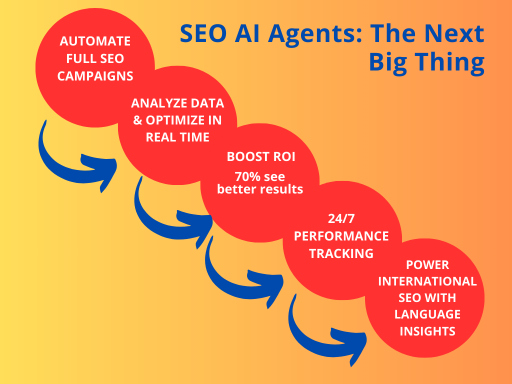
A 2026 report highlights that 71% of companies now rely on generative AI for content creation (up from just 33% in 2023). But the real win comes from blending humans with AI: hybrid workflows boosted traffic by 31%, compared with fully AI-generated content, which dropped performance by 12%.

The brands winning today are the ones treating AI as a strategic partner rather than a shortcut. They’re using various platforms to maintain brand memory, streamline publishing, and keep content consistent while still layering in human insight for authenticity. Many content teams also rely on the best AI humanizing tools to refine AI-generated text, making it sound more natural, engaging, and aligned with their brand voice. For example, platforms like Sintra AI give teams an AI helper that can automate routine content and business workflows, making it easier to streamline publishing and maintain consistency without losing human oversight.
Here’s an interesting discussion on the topic of creating content with AI:
While SERP positions still matter, brands measure success through prompt testing, AI citations, and visibility within answer engines.
This is the new reality of search.
Why AI-Driven SEO Matters in 2026
AI SEO matters because users tend to trust synthesized citations far more than a list of blue links, and AI consistently pulls from content that demonstrates real expertise: case studies, firsthand experience, and proof that a human actually knows what they’re talking about.
Once you start appearing in decision‑stage AI answers, those “best alternatives” and “top options” moments, you’re suddenly on every shortlist without the user doing any extra research.
This is important for two reasons:
1) It cuts friction dramatically and speeds up deal cycles, with many companies seeing prospects move from awareness to purchase nearly twice as fast simply because AI positioned them as the authoritative choice.
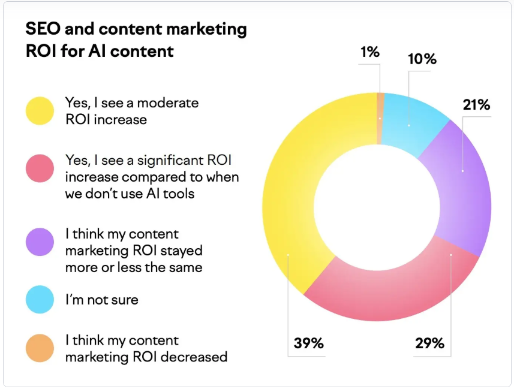
As SemRush reports, around 68% of companies have declared they’ve seen higher return on investment (ROI) from using AI in SEO.
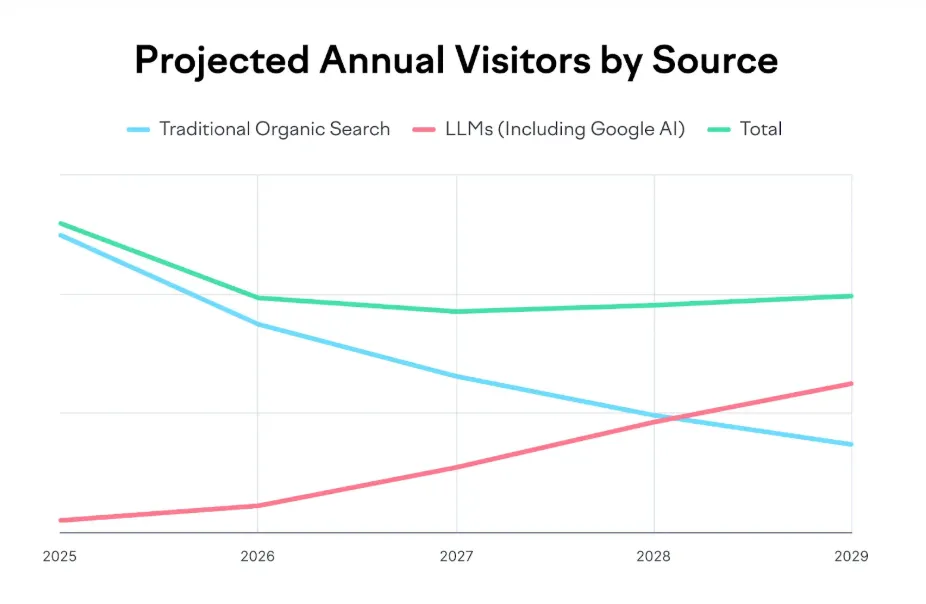
2) Recent research shows that AI-driven search traffic could overtake traditional search traffic by 2028.
How AI-Powered Search Engines Understand Content
AI chats, voice assistants, social platforms, and every emerging engine interpret intent.
The way AI search engines read text is exactly the way a human would.
The major difference lies in the fact that they use advanced NLP, machine learning, and semantic analysis to interpret intent, context, and the relationships between ideas. Unlike the classic SEO obsession with keywords, these systems look for meaning, clarity, and authority.
They measure semantic similarity, so phrases like “fix” and “repair” land in the same bucket and analyze sentence structure to catch nuance.
And with models like BERT and MUM, your content gets transformed into vector embeddings, mathematical representations that help AI compare ideas contextually. Add structured data into the mix, and these systems tap straight into the details that matter most.
AI Overviews & The New Rules for Traffic
AI Overviews has brought in these new traffic rules:
- Citation priority: AI favors structured, entity‑rich content, pulling directly from pages it can easily understand. If you’re not being cited in AI answers, you have fewer chances of being seen in SERPs.
- Selection logic shift: Traditional rankings typically reward high-traffic pages. Conversely, AI Overviews cite sources based on semantic relevance and topical authority, not historical traffic. Pages that cover connected terms within the same lexical field and reinforce entity relationships have a higher chance of being referenced.
- Optimization focus: Clean schema, tight answers, and human‑proof assets like case studies make your content irresistible to AI systems looking for authoritative sources.
Now, you’re probably wondering if there are still pages that earn clicks from the traditional SERP. And the answer is yes. Deep, complex, decision‑stage content continues to win because users click through when they need more than a quick AI summary.
Some examples:
How an SEO Content Strategy With AI Tools Looks in Practice
What follows is an advanced AI SEO playbook for 2026, step by step, translating strategy into real execution.
Define Your Strategic Foundation
When search engines care more about entities, intent, and E‑E‑A‑T than raw keyword density, you need a foundation that ties your business goals to what your audience actually needs.
That foundation comes from getting a few essentials straight.
- A clear picture of what success looks like: more qualified traffic, stronger conversions, or better visibility in AI‑generated answers.
- Understand your audience: who you’re speaking to, what they’re trying to solve, and how their intent shifts as they move from early research to decision‑making.
- An honest audit of where you stand today: what content is pulling its weight, where the gaps are, how technically sound the site is, and whether AI systems can even interpret your structure.
Once those pieces are in place, you stop chasing isolated keywords and build entity‑driven topical authority.
So, build the SEO content strategy with AI around semantic relationships and design workflows where human expertise and AI assistance work together. Your content stays authentic, scalable, and aligned with how modern search actually behaves, including the rise of zero‑click answers.
Set goals that actually match how AI search works, so you can earn AI citations, apart from climbing traditional rankings.
Understand How AI Prompting Works
Take this AI prompt example:
“Summarize the top pain points for [ICP] who struggle with [problem your SaaS solves].”
This is the kind of building block you’d include in a set of 10 prompts to simplify your SEO strategy with AI because it gives the model the right constraints to produce usable insight.
First off, let’s summarize the difference between retrieval and generation, which are AI’s main methods of “knowing” things.
- Retrieval: the model recalls widely known facts, common industry patterns, or well‑established concepts. It gives the impression that it’s “looking something up,” but it’s really pulling from learned associations.
- Generation: the model creates new phrasing, examples, frameworks, or explanations based on those associations.
In essence:
- Retrieval gives you the baseline (e.g., common pain points in B2B SaaS)
- Generation gives you the angle (e.g., a fresh way to frame those pain points for your audience)
Rely only on retrieval, and your content will sound like everyone else’s. But if you guide the generation, you get originality.
Secondly, an adequate AI output relies on relevance, which is driven by signals. AI prioritizes what seems most relevant based on context, recency, and semantic similarity.
The more context you give, the more relevant the output. Constraints like tone, audience, format, or examples help the model stay on track. Plus, asking the model to “think step by step” or “explain your reasoning” can improve accuracy.
Build a Keyword Universe Using AI
- Kick things off with 5–10 core seed keywords tied to your goals and audience intent. Feed those into tools like Ahrefs, SEMrush’s AI features, or ChatGPT paired with Google Ads or DataForSEO, and you’ll instantly unlock hundreds or thousands of related terms, trends, and patterns.
- Start spotting structures, using models like Entity + Action + Value, layering in autosuggest data, “People Also Ask,” Google Trends, Exploding Topics, and even your own first‑party data from Search Console or competitor research.
- The next move is intent. AI can quickly classify queries by whether people are researching, comparing, or ready to buy. This helps you prioritize the clusters that actually move the needle. It’s also where long‑tail, conversational queries shine; they’re increasingly the ones AI search surfaces first.
- Cluster at scale. AI tools like Juma, Keyword Insights, or Zenbrief can process massive keyword sets and group them by semantic similarity, SERP overlap, or embeddings.
What you get back is a clear map of pillars and subtopics, complete with volume, difficulty, and traffic potential. It’s a structure that makes content planning faster and far more aligned with how AI search engines understand the world.
Create Topic Clusters & Pillar Pages
Start with a pillar page and think of it as your home base: the place that explains the subject from top to bottom and gives readers (and search engines) a clear signal that you actually know what you’re talking about.
From there, spin out the supporting pieces: articles that tackle one question, one angle, or one pain point at a time. Where the pillar paints the full picture, these zoom in on the details.
Example: Here’s what that would look like for an email warm-up SaaS brand:
Pillar: Email Deliverability Guide
Cluster articles:
- Why emails go to spam
- What domain warm-up actually is
- How to fix a low sender reputation
Each post stands on its own, but together they tell a complete story.
This is how you map the entire ecosystem in minutes. AI tools can identify subtopics, spot gaps, and suggest logical link paths.
Use AI to Generate Content Briefs
- Start with feeding the AI tool the right inputs: your keywords, strategy, and audience, and let it draft an outline that’s structured for search.
- Shape it by adding your brand voice, your angle, and your expertise.
- Add in SERP patterns, gaps, “People Also Ask” questions – these all help you understand what readers expect and where you can stand out.
- Tell the AI tool details regarding structure: H1-H3 outline, word count, format (whether guide, listicle, etc.)
- Export it into whatever system your team uses.
The real key is to always give briefs a human review to make sure they match your brand and reflect what’s happening now, not last year’s trends.
Track how each brief performs in terms of rankings, traffic, and even AI citations. Then use this data to tighten your process.
Here’s a prompt example considering the same email warm-up SaaS brand:
“Create a detailed SEO content brief for the keyword ‘email warm‑up timeline’ including outline, subtopics, FAQs, and internal linking suggestions.”
You can also standardize workflows with 10 prompts to simplify your SEO strategy with AI, reducing planning time without sacrificing depth.
Check these examples of tools to use, depending on your scale and setup:
Create Content Optimized for AI Search and Overviews
Creating content that actually shows up in AI‑driven overviews is about giving clear, authoritative answers that AI systems can lift directly: short, confident explanations up front, with the depth and proof right behind them.
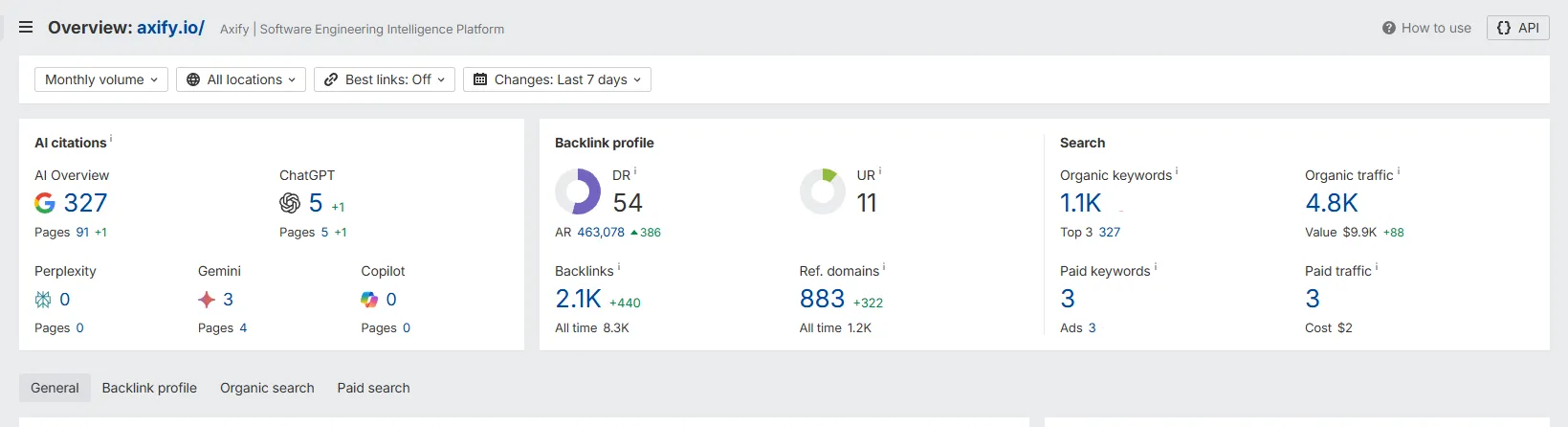
We applied this approach with Axify, and it led to over 300 AI Overviews for the brand (see below).
Use question‑based subheads so both humans and machines instantly know what you’re addressing. Then support those answers with the signals that show you know your stuff: clear sourcing, real data, author expertise, and anything that reinforces trust.
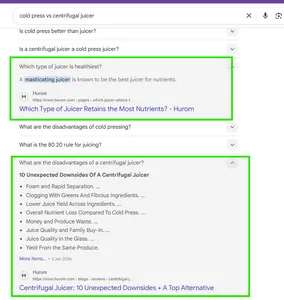
And don’t forget how people actually search now. Long‑tail, conversational questions are everywhere, especially the ones pulled from “People Also Ask.” In essence, your content should mirror the way people naturally phrase their questions.
It’s exactly what we did for Hurom, another one of our clients:
Here are more examples of formats that have proven to increase AI citations:
Build Authority & Trust in an AI-Driven World
Building authority and trust still revolves around prioritizing E-E-A-T (Experience, Expertise, Authoritativeness, Trustworthiness), except now the shift moves from volume to verifiable depth.
That means:
- Experience: Show you’ve actually done the work: real case studies, screenshots, metrics, before‑and‑after results. A simple line like “Our team grew a client’s traffic 3x using this exact playbook” carries more weight than any generic claim.
- Expertise: Put real names on your content. Add author bios, credentials, and links to their LinkedIn or past work.
- Authoritativeness: Build out strong topical clusters, interlink them, and earn mentions from reputable sites. Backlinks, quotes, and expert references all reinforce that you’re an expert in a topic.
- Trustworthiness: Cite your sources. Use primary data. Add last‑updated dates. Be transparent about where AI was used and keep the substance. The cleaner and more honest your content is, the more likely AI systems are to surface it.
You need to handle off‑site signals, too, and build trust where people and algorithms are already paying attention.
- Get your name on high‑authority sites through guest posts, HARO link building, PR hits, and expert mentions.
- Build brand memory with reviews on platforms like G2 and Capterra, and if possible, show up in places like Wikipedia or PR Newswire.
- Don’t underestimate community presence, like Reddit AMAs, X threads, podcast interviews – anywhere your expertise can be linked back to your domain.
And here’s what Lana Volkov, SEO & Content Strategy Consultant at Moz, predicts:
“In 2026, brand visibility in AI search results will hinge on trust. Earned media, such as social mentions, reviews, and high-quality backlinks, will play a key role in shaping how AI models and users perceive your brand.”
Track What Matters for an AI SEO Strategy
Tracking the right metrics in an AI‑driven SEO strategy is all about AI citations, visibility in AI summaries, and real business impact.
The truth is, showing up in AI Overviews often converts better than a classic SERP win. Influence, like citations and authority signals are the new currency. And AI is ridiculously good at spotting trouble early, like impression dips before traffic tanks, giving you time to fix issues before they cost you.
Core Metrics
Rankings: You need to still track your keyword positions in GSC or Semrush, but don’t stop there. A top‑3 ranking means nothing if AI summaries steal the clicks.
Visibility: Measure how often you appear in AI Overviews, ChatGPT, and Perplexity. You can rely on tools like SE Ranking’s AI Visibility Tracker to monitor your share of voice. Keep in mind that your goal is to get consistent mentions across engines.
Influence: Look at citations, brand sentiment, and E‑E‑A‑T signals, like authoritative backlinks and expert mentions. Semrush Copilot can surface the competitor momentum you need to counter.
AI for early signals: AI can catch decay patterns long before humans do. If you notice drops in CTR with stable rankings, that’s an early warning. Predictive tools can flag volatility from competitor moves or algorithm shifts. Pair this with GA4 baselines and automated Looker Studio dashboards to get weekly alerts when impressions start slipping.
Here’s how to implement your tracking tools:
- Connect GSC, GA4, and Semrush; monitor impression‑to‑click ratios.
- Run AI audits (Wellows, ZarkX) to track decay scores and citation trends.
- Test prompts in Perplexity and ChatGPT weekly to benchmark your visibility.
Adapt and Future-Proof Your SEO Strategy
If you want your SEO to survive the next wave of AI model updates, you can’t just optimize pages.
AI-proofing your SEO strategy means focusing on durable foundations:
- Entity strength
- Topical depth
- E‑E‑A‑T signals that hold up no matter how Google or OpenAI tweak their models
As we mentioned above, build topical authority by connecting pillar pages with tightly aligned supporting content. Layer in real proof: expert quotes, data, third‑party mentions, so your pages feel credible to both humans and LLMs.
And don’t skip structured data; clean JSON‑LD makes your content easier for AI to extract and reuse.
Preparing for SGE and model shifts means watching the right signals.
- Track AI‑specific metrics like citation frequency and Overview impressions.
- Test your visibility weekly or monthly in ChatGPT and Perplexity to see where you’re mentioned or ignored. Run quarterly audits to catch early decay, and use predictive AI tools to flag volatility before it hits traffic.
Finally, keep your content “LLM‑ready”: crawlable, scannable, and structured to answer tasks directly. A quick health check on clarity, freshness, and review signals goes a long way in staying visible across engines.
How to Stay Ahead of AI SEO Changes?
Keeping an AI-driven SEO strategy effective takes ongoing attention. You can rely on automated tools to catch technical issues early and predict volatility.
But if you want to AI-proof your SEO strategy, you need consistent habits:
- Testing your visibility in AI experiences
- Tracking how often you’re cited
- Watching competitors for sudden gains that signal shifting model preferences
When something triggers an alert, move quickly: tighten your trust signals, undo any changes that might be hurting performance, and keep everything organized in one clear dashboard so you can spot patterns and shifts without digging around.
And because AI Overviews and search models evolve constantly, SEO teams need to stay sharp, keep learning, and adapt quickly to keep pace with how search actually works now.
Underneath all this, the fundamentals still win.
- Build entity and topical depth: interlink clusters around core themes, not just keywords, and use schema so AI can easily extract your answers.
- Run hybrid workflows where AI drafts, humans refine, and every key page is backed by real expertise, data, and social proof (your E‑E‑A‑T flywheel).
- Optimize for AI agents and conversational interfaces with clear FAQs and comparison‑ready content; extend those ideas into YouTube, Reddit, TikTok, and your own email or app channels. FYI, about 70% of the top 100 Google search results for commercial searches include at least one YouTube video.
The more places your story lives, the less any single algorithm change can shake you.
Build an AI-First SEO Strategy That Powers Your Pipeline With Bluethings
SEO in 2026 is no longer about betting everything on classic SERPs. What matters now is to show up wherever buyers look for answers, shaping decisions long before a sales call happens.
With AI becoming a core layer of search, discovery, and evaluation, B2B SaaS brands should treat the SEO content strategy with AI as a revenue influence channel.
An effective AI-driven SEO strategy connects your content, your expertise, and your buyer’s intent across every surface where people search, whether that’s Google, AI assistants, or comparison tools. When your content is structured for understanding, trusted for expertise, and aligned with real use cases, AI systems surface your brand naturally throughout the buying journey.
Key Takeaways:
- Shift your attention from keyword-led tactics to intent- and entity-driven SEO.
- Go beyond blue-link rankings and optimize for visibility across AI answers.
- Build topic ecosystems that establish authority.
- Align content with buyer stages, from education to comparison to decision.
- Make your content easy for AI systems to extract, summarize, and cite it.
- Boost trust with original insights, data, and clear author credibility.
- Track all AI mentions, citations, and assisted conversions.
- Treat SEO as buyer enablement, not content production.
If you want to future-proof your SEO strategy and turn AI-driven visibility into measurable pipeline impact, our team can help. We work with B2B SaaS brands to design, execute, and evolve SEO programs built for how buyers and AI systems actually work today.
Get in touch to build an SEO strategy that earns trust, influences decisions, and performs in 2026 and beyond.
FAQs
- How is traditional SEO different from AI SEO?
Traditional SEO focuses on rankings, backlinks, and on‑page optimization. AI SEO expands the scope to visibility in AI summaries, citations, entity strength, and how well content is used by AI systems. It prioritizes semantic depth, authority signals, and performance across AI Overviews, ChatGPT, and Perplexity.
- What should you do to rank in AI comparisons?
Provide clear, structured, expert‑backed content that answers comparison‑style queries directly. Strengthen entities, citations, and trust signals. Use product specs, pricing, pros/cons, and unique value points. Ensure your brand appears consistently across AI engines by optimizing for clarity, authority, and verifiable data sources.
- What type of content performs best for AI-first SEO strategies?
AI favors content that’s authoritative, structured, and fact‑rich. Think expert explainers, comparison breakdowns, FAQs, data‑driven insights, and clearly sourced claims. Content that demonstrates E‑E‑A‑T, includes concise summaries, and answers intent‑level questions directly tends to surface more often in AI‑generated responses.
- How do you measure AI-assisted pipeline impact?
Track AI visibility, citations, and impression‑to‑click shifts alongside GA4 conversions. Allocate assisted conversions from pages frequently appearing in AI summaries. Monitor influenced pipeline using multi‑touch models, branded search lift, and changes in demo requests or revenue tied to AI‑exposed content.
- How often should you update content for SEO & AI?
Ideally, you should refresh high‑value pages quarterly based on impression trends, citation changes, and competitive shifts. Update stats, comparisons, pricing, and expert insights. AI‑first SEO rewards freshness, clarity, and accuracy, so prioritize pages showing early decay signals or declining visibility in AI engines.