SEO audit services are usually the first meaningful step toward improving and protecting your organic search performance. When rankings stall or traffic drops, many businesses try to fix things by publishing more content or building more links without really understanding what’s holding their site back.
A proper SEO audit helps uncover those root issues.
The challenge is that not all audits are created equal.
Some rely on basic, automated checklists, while others offer deep technical analysis, clear prioritization, and actionable insights you can act on. Differences in audit depth, quality, and usefulness can have a real impact on your search visibility, user experience, and overall conversion performance.
In this guide, we’ll explain:
- What professional SEO audit services include
- How much they typically cost
- How to evaluate providers
Let’s dive in.
TL;DR
- SEO audit services identify what limits rankings, traffic, and conversions, then prioritize fixes that drive real results.
- A professional audit covers technical SEO, on-page optimization, content quality, backlinks, and user experience.
- Automated audits find surface issues, while expert audits add context, prioritization, and strategy.
- Pricing typically ranges from $300 for basic scans to $5,000+ for deep, strategic audits, depending on site complexity.
- Strong providers explain why competitors outperform you, focus on root causes, and connect SEO fixes to business impact.
- An SEO audit works best as a living roadmap that guides ongoing growth, not a one-time report.
What Is an SEO Audit Service?
An SEO audit service is a professional evaluation of how well your website performs in search engines and where it’s falling short. It examines technical SEO, on-page SEO, off-page SEO signals, content quality, and user experience to uncover issues that limit search visibility, organic traffic, and conversion rates.
This matters because hidden issues are common. Research from SEMRush shows that over 80% of websites have at least one critical technical SEO issue, usually without site owners realizing it.
Here’s a good idea of how an SEO audit works:
You can do it with basic SEO tools, and we advise you to schedule automated website audits.
- These automated scans have:
- Advantages: Can identify broken links, missing meta descriptions, crawl errors, slow site speed, or poorly optimized title tags.
- One disadvantage: They rarely explain impact or priority.
On the other hand, a professional, full SEO site audit evaluates:
- Context
- User intent
- And search engine algorithms
That way, they can determine what’s actually affecting SEO performance.
Plus, it helps you prioritize fixes, which is more important than you think.
The point isn’t just to improve website performance, but to protect search rankings and make sure that your future SEO efforts are built on a stable, scalable foundation.
Here’s an example from one of our recent audits.
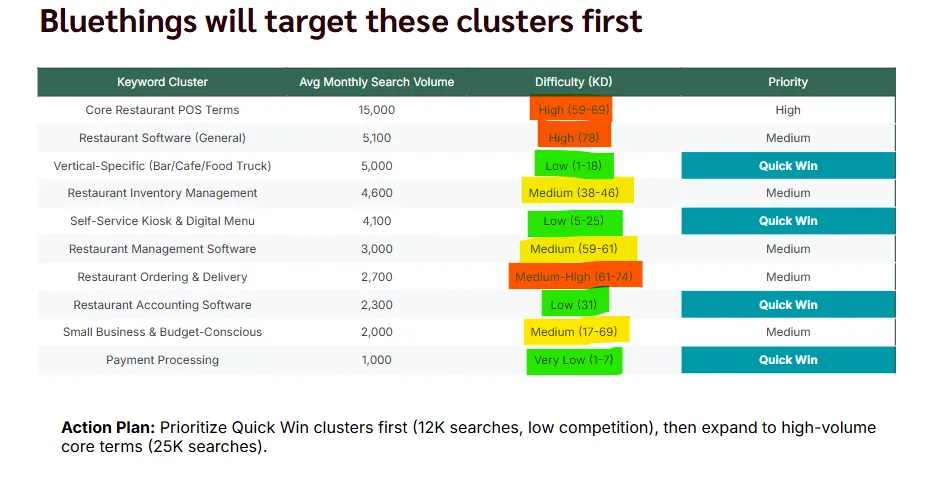
Instead of sending the client a long list of generic issues, we:
- Grouped their keywords into clear clusters based on search volume, competition, and real business value.
- Labeled each one by priority.
This made it obvious what they should focus on first and what could wait.
For example, we highlighted low-competition clusters with strong intent that could drive results quickly, while also outlining a longer-term strategy for more competitive core terms.
Pro tip: If you’re interested in the topic, grab our free keyword research checklist.
This is what clients can expect from our audits: clear direction, practical next steps, and a plan that ties SEO work to actual growth, not just a cleaner-looking website.
What’s Included in a Professional SEO Audit?
A professional SEO audit evaluates your website’s technical foundation, content quality, authority signals, and user experience. These factors directly influence search rankings, organic traffic, and conversion rates. Below is what a comprehensive audit should actually include, and why each part matters.
On-Page SEO Analysis
This portion focuses on how well individual pages are optimized for both search engines and people. A professional on‑page review will typically:
- Review page titles, meta descriptions, header structures, and internal linking.
- Assess keyword usage, search intent alignment, and content structure.
- Identify duplication, keyword cannibalization, or missed optimization opportunities.
Here’s the problem:
According to Wordstream, Google rewrites over 61% of meta titles and nearly 63% of meta descriptions, usually because they’re too long, too short, or not aligned with user intent. This shows how often on‑page elements are imperfect in the wild.
So, the goal here is to make sure each page has a clear purpose, targets relevant queries, and supports stronger search visibility.
Let’s take this example:
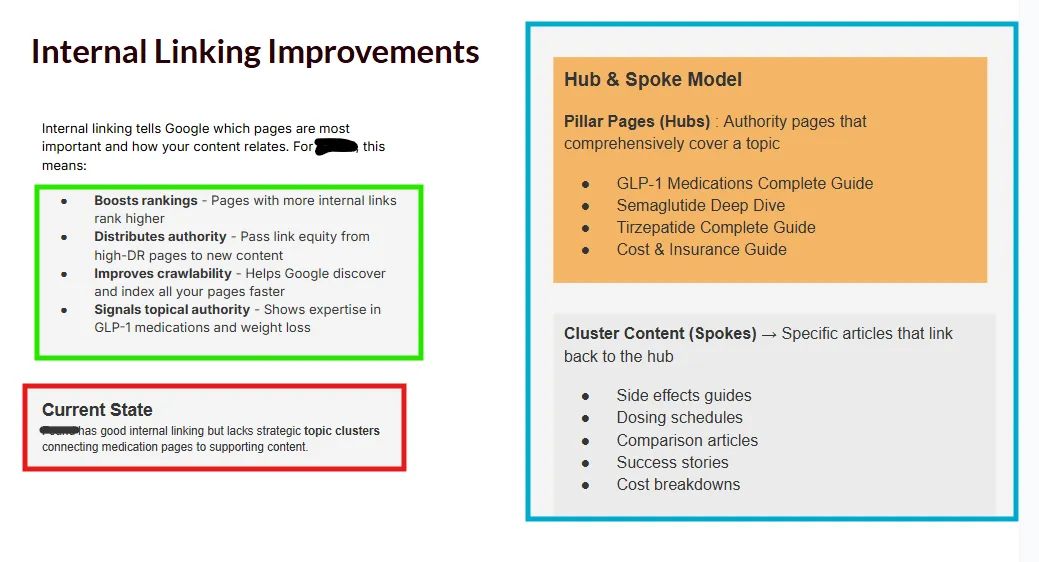
For this client, we:
- Explained their current state with internal links
- Explained the benefits they can get from improving this
- Discussed the hub & spoke model specifically because it brings them the most benefits
Technical SEO Assessment
Technical SEO ensures search engines can crawl, index, and understand your site correctly, and this is where many sites struggle. This analysis usually covers:
- Crawlability, indexing, site speed, and mobile performance
- Redirect issues, broken links, crawl errors, and site architecture
- Schema markup, structured data, and compliance with technical best practices
Technical bottlenecks will explain why great content fails to rank, even when it’s well written.
Here’s a fun fact:
For every 1‑second delay in page load time (from 1 s to 3 s), the probability a visitor leaves (bounce rate) increases by about 32%. This proves how crucial speed and performance are for both users and search engines.
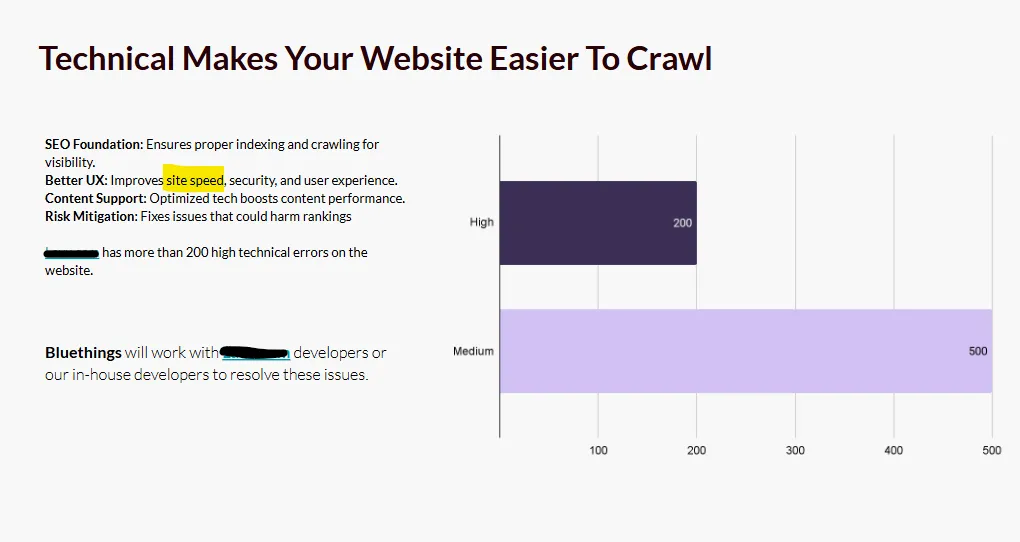
It’s also why we at Bluethings take it into account when we conduct SEO audits for our clients.
Here are other issues we typically include in our audits:
Backlink and Authority Review
Authority signals help search engines assess trust and relevance. A backlink review will:
- Analyze backlink quality, relevance, and overall authority.
- Flag toxic or risky links that could harm performance.
- Evaluate your backlink profile balance and competitive positioning.
This helps protect your site from penalties and informs smarter link‑building decisions that support long‑term growth.
The problem is that more than 66% of pages have zero backlinks pointing to them.
That means most content isn’t supported by external authority signals, which is a big reason many pages don’t rank well. At Bluethings, we will:
- Recommend what pages and keywords to build links to
- Build those backlinks
Here’s how our backlink recommendations look:
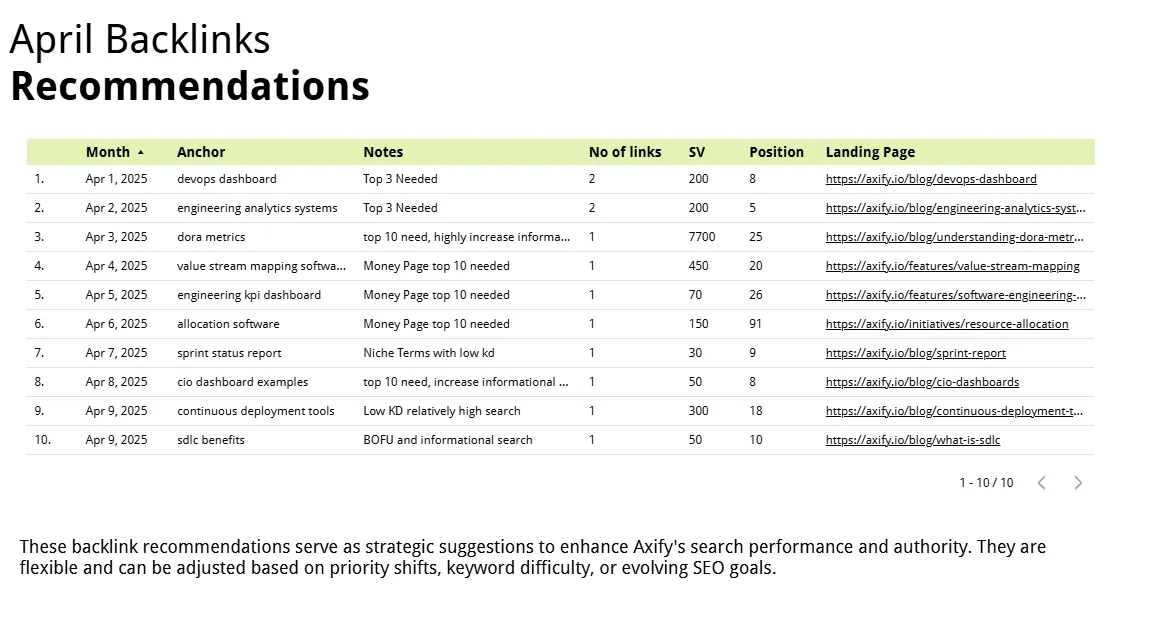
You can see that we build links to landing pages as well as articles to increase EEAT.
The point is, we always pick the most important keywords according to our clients’ products/ services. In this case, for Axify, we decided to focus on their most important metrics dashboards, and features.
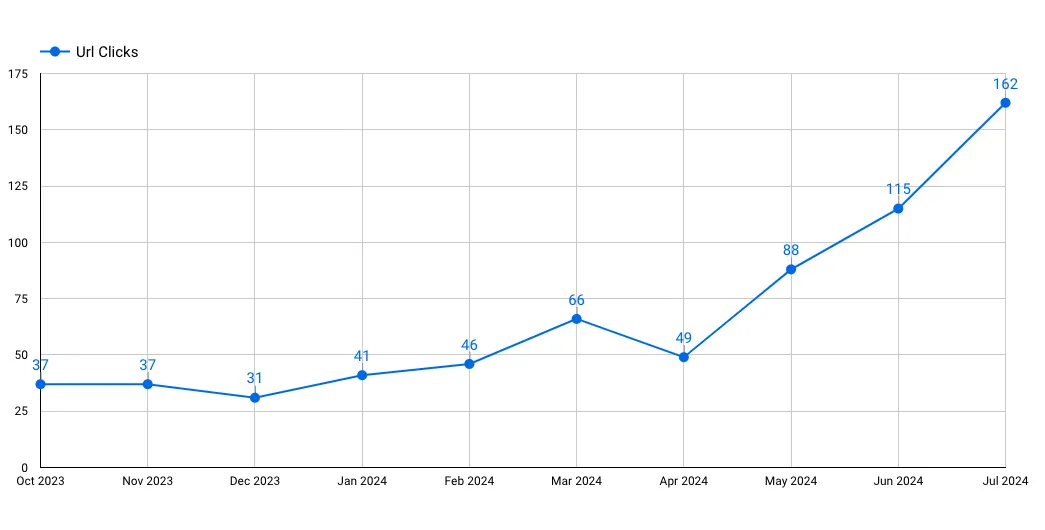
With strategies like these, we:
- Improved their SEO performance by 175%
- Helped them rank for 297 new keywords
Increased their clicks by 50%
Content Quality and Optimization Review
A strong content audit looks beyond keyword counts to evaluate real performance and value:
- Review content depth, freshness, and engagement metrics
- Identify thin, outdated, or underperforming pages
- Highlight opportunities for consolidation, expansion, or pruning
According to research, more than half of published content fails to attract meaningful organic traffic, typically because it doesn’t align with search intent or provide enough depth. This is exactly why a thorough content and on-page review is critical during an SEO audit.
Here’s a good example of our work.
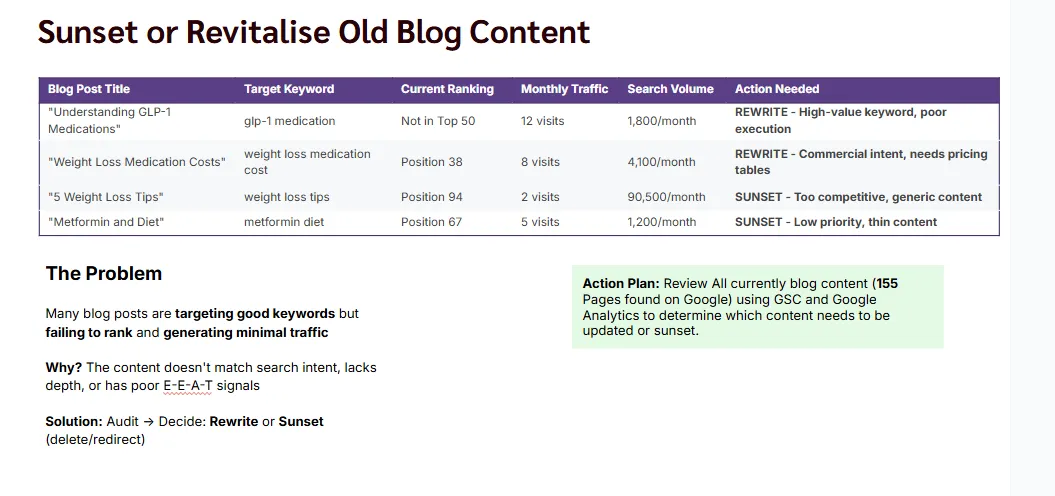
For one client, we found that some of their articles were targeting good keywords, but weren’t ranking. So, we recommended a website audit to decide what articles to delete and which to rewrite.
In the screenshot below, you can see some of our recommendations and explanations. For example:
- Articles targeting high-value keywords with poor executions can be rewritten, but:
- Articles targeting very competitive keywords, with low priority, can be deleted.
User Experience (UX) and Engagement Signals
Search engines now consider behavioral and page experience signals (like bounce rate, dwell time, layout stability, and mobile usability) as essential contributors to ranking.
Strong user experience supports better engagement and higher conversion rates, and also helps stabilize rankings over time.
The problem is that this blurs the line between UX and SEO.
A UX‑focused audit will:
- Evaluate navigation clarity, layout, and overall page usability.
- Review metrics like bounce rates, dwell time, and conversion bottlenecks.
- Connect UX findings directly to SEO performance and conversion paths.
Together, these components make up a professional SEO audit service and strategic roadmap. They help businesses understand what’s holding performance back and where to focus next for measurable growth.
But can you afford your SEO audit?
That brings us to the next point:
How Much Do SEO Audit Services Cost?
SEO audit services don’t come with a single fixed price. Costs vary based on audit depth, website complexity, and how much strategic guidance you receive after the analysis.
Understanding typical pricing tiers helps you avoid paying for reports that simply list problems without giving you a clear path to improvement.
Typical SEO Audit Pricing Ranges
Most professional SEO audit services fall into three broad tiers:
Pricing varies widely because audit scope and effort differ significantly from one business to the next. For example, comprehensive audits can take dozens of hours of expert analysis, especially for large e-commerce or enterprise sites.
Factors That Influence SEO Audit Costs
Several key factors directly affect pricing:
- Website size and complexity, including total page count and template variations
- Business type, such as local, e-commerce, SaaS, or enterprise
- Depth of technical analysis, content evaluation, and backlink review
- Level of reporting, prioritization, and post‑audit strategic guidance
More complexity means more time, expertise, and interpretation, all of which increase cost.
Why Cheaper SEO Audits Aren’t Always Better
Low‑cost audits can lean too much on automation and generic templates.
While these do surface some data, they rarely explain why issues matter or which fixes will actually move the needle.
In contrast, professional SEO audit services add value by applying expert interpretation, clear prioritization, and strategic direction. This helps you focus on changes that actually improve search visibility, user experience, and conversion rates over time.
How to Choose the Right SEO Audit Service
Choosing the right SEO provider matters just as much as the SEO audit itself. Unfortunately, many businesses end up with a long PDF full of issues they don’t understand and never implement.
That’s what you want to avoid, so here’s what we recommend:
1. Do They Show You Where You Can Actually Win?
A lot of audits focus on everything that’s broken. That’s not very useful if half those fixes won’t move performance.
What you want is a provider who helps you spot leverage.
- Where are the easiest gains?
- Which areas are competitive but still beatable?
- Which parts of your site deserve real investment?
As you’ve seen in our audits, we like to group keywords into intent-based clusters, then assign priorities like Quick Win, Medium, or High, like so:
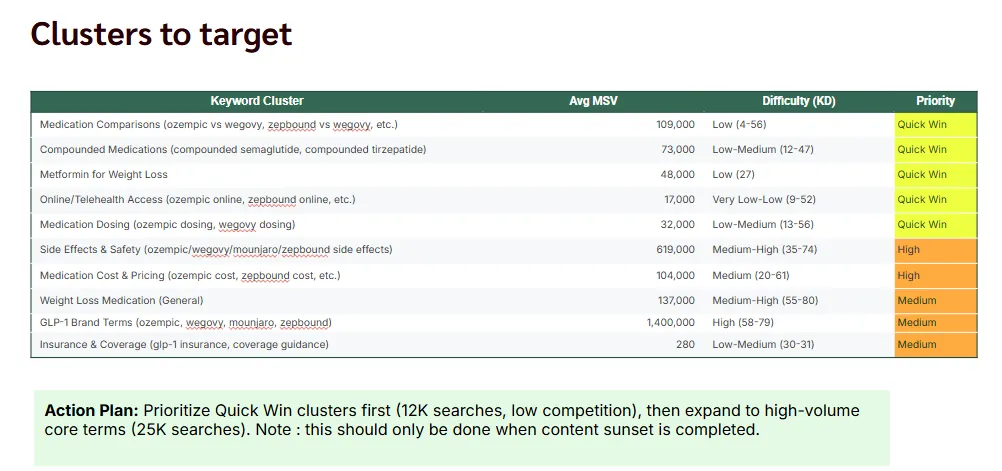
That way, clients can immediately see what’s likely to drive results now versus what belongs in a longer-term roadmap.
Remember: If an audit doesn’t help you choose, it’s not strategic.
2. Can They Explain Why Competitors Are Beating You?
SEO is relative. You’re not ranking in isolation.
A strong audit should show how your site compares to others in your space and explain why some competitors outrank you even when your content looks similar.
For example, we at Bluethings like to visualize domain authority gaps to show clients that the issue isn’t (always) their writing. It can also be trust, links, and brand signals.
That changes the entire strategy. Instead of endlessly rewriting content, the focus shifts to credibility and authority-building.
Here’s what we did for one of our clients:
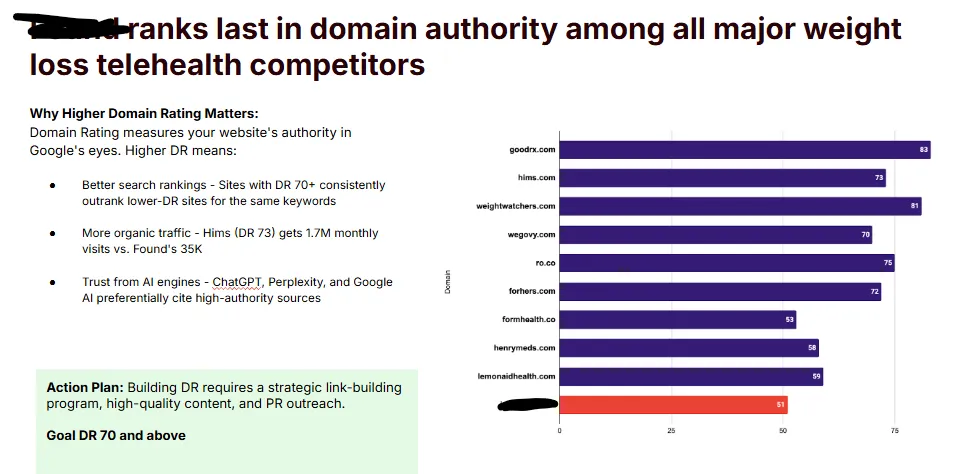
why a higher DR matters, the goal they need to set, and how to achieve it.
Remember: If a provider can’t explain why others are winning, they won’t know how to help you catch up.
3. Do They Focus on Root Causes, Not Just Symptoms?
Weak audits list symptoms:
- Missing tags
- Thin pages
- Broken links
Strong audits diagnose causes:
- Why content fails to satisfy intent
- Why Google doesn’t trust the site
- Why crawl budget is being wasted
- Why internal authority isn’t flowing
This difference matters because fixing symptoms keeps you busy, but fixing root causes changes outcomes.
We usually show this by mapping keyword rankings against actual traffic impact, as you can see in the screenshot below:
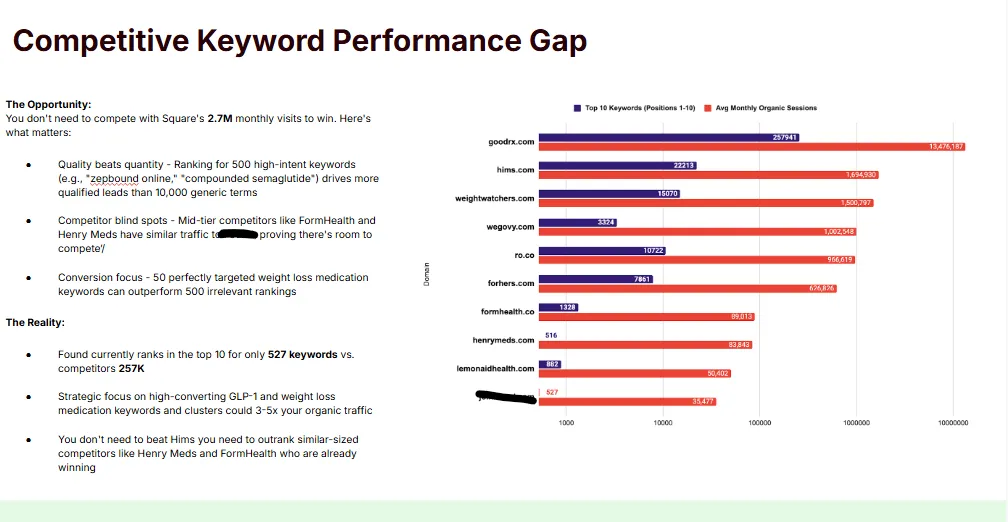
Sometimes a site ranks for hundreds of terms and still underperforms because those rankings don’t convert or attract qualified users.
4. Will This Audit Still Matter in Six Months?
A surprising number of audits become outdated almost immediately because they focus on short-term fixes.
A good audit improves your system, so it should:
- Influence how future content gets planned
- Shape how site architecture evolves
- Prevent the same mistakes from being repeated
- Create rules your team can follow going forward
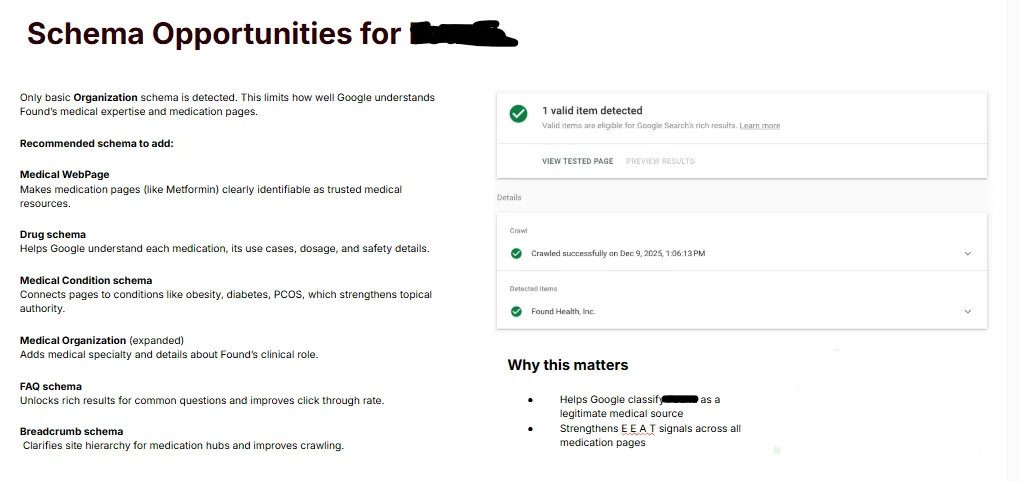
When we point out missing schema types or structural technical issues, we explain how they affect classification, trust, and long-term topical authority, so future pages are built correctly from the start.
Here’s how we proceeded for one company in the medical industry, uncovering multiple schema opportunities like a medical web page schema, drug schema, FAQ schema, and even breadcrumb schema.
5. Do They Translate Technical Issues Into Business Impact?
If an SEO audit provider can’t explain technical problems in plain language, that’s a problem.
You should understand:
- What’s blocking discovery
- What’s slowing down indexing
- What’s confusing search engines
- What’s weakening trust signals
At Bluethings, we show this with simple visual breakdowns of crawl, indexing, and structural issues so clients can immediately see what’s holding their site back and why it matters.
For one company, we identified multiple body tags and invalid head elements as their main technical SEO issues, as you can see below:
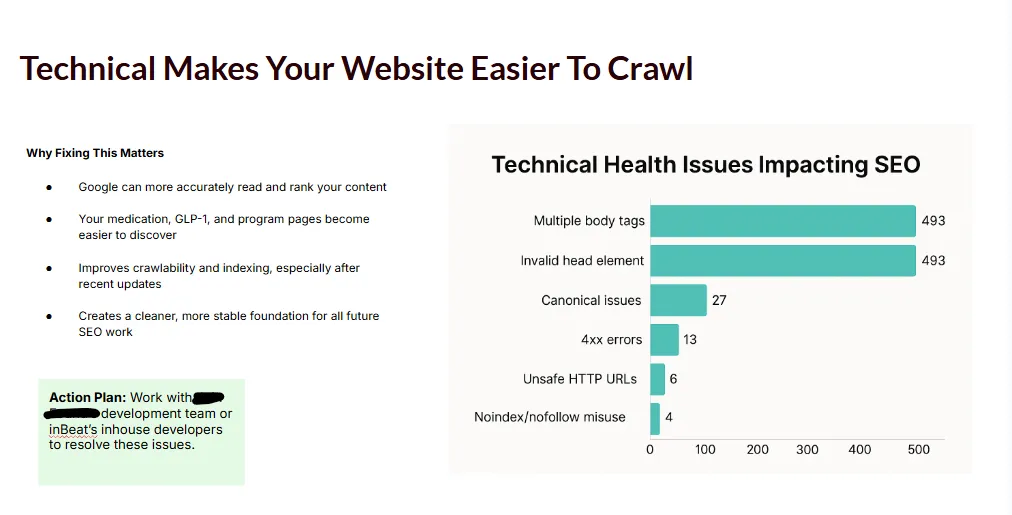
But more importantly, we explained why fixing these issues matters and provided an action plan to do so.
6. Does Success Mean More Than Just Rankings?
Rankings are not the goal. They’re a proxy.
A strong provider ties audit findings to:
- Traffic quality
- Conversion paths
- Brand demand
- Long-term growth
That’s why we always show how technical cleanup, structural changes, and content realignment translate into real growth over time.
Here’s a page out of one of our reports, focusing on MoM growth, YoY growth, and direct searches.
.webp)
7. Match the Audit to Your Business Model
SEO problems look very different depending on the type of business you run.
For example:
- E-commerce sites struggle with crawlability, faceted navigation, thin product pages, and duplication
- SaaS sites struggle with intent alignment, feature pages, and content that doesn’t convert
- Local businesses struggle with local signals, inconsistent NAP data, and weak location pages
If your provider can’t explain what typically breaks SEO in your business model, they probably won’t catch the real issues on your site.
Ask Questions That Reveal How They Think [and Beware the Red Flags]
Before hiring, ask questions that force the provider to explain their process.
For example:
- How do you decide what to fix first?
- How do you connect SEO issues to business impact?
- What happens after the audit is delivered?
- Will someone walk me through the findings?
Be cautious if a provider:
- Promises guaranteed rankings.
- Uses one-size-fits-all templates.
- Avoids explaining their reasoning.
- Focuses on the volume of issues rather than the impact.
Remember: You’re not just buying a report. You’re buying thinking. If they can’t clearly explain how they evaluate, prioritize, and interpret findings, that will show up in the final deliverable.
What Happens After an SEO Audit?
An SEO audit isn’t the finish line. It’s the starting point. The value only shows up when recommendations turn into action, and your website improves as a result.
Turning Audit Findings Into Action
A solid audit should come with a clear roadmap.
Expect to see:
- Issues grouped by priority (critical, high, medium, low)
- Fixes mapped to key SEO areas like technical health, on-page optimization, content quality, and user experience
- Practical next steps focused on boosting visibility, removing blockers, and strengthening conversion paths
Even the best audit won’t help if it sits untouched. Progress only happens when the findings are implemented.
Internal Execution vs. Agency Support
Once the audit is delivered, most businesses choose between:
- Internal execution: Works well if you have in-house developers or a web team, internal content or marketing resources, and some SEO knowledge or oversight.
- Agency or consultant support: Best if you need help with complex technical fixes, large-scale site structure, or content issues, and are limited in-house time or bandwidth.
Many teams go hybrid, tackling quick wins internally while outsourcing high-impact changes to experienced SEO pros.
Pro tip: Not sure how to get started? Here’s our complete guide to outsource SEO.
Treat Your SEO Audits as a Living Document
Search changes fast. So does your website:
- Search engines update constantly
- User behavior evolves
- Your site grows and shifts with new pages, products, or content
Make the audit part of your ongoing SEO strategy by revisiting key issues during quarterly reviews or before major updates.
Turn Your SEO Audit Into a Growth Strategy, Not a Report
An SEO audit is more than a diagnostic. Done right, it’s a strategic reset.
It gives you clarity at a time when guessing is expensive. Instead of investing blindly in content, links, or paid campaigns, a professional audit shows you exactly what’s holding your site back, what’s working, and where to focus first.
The difference comes down to depth. Shallow audits list problems. Great audits prioritize action, explain why things matter, and tie fixes directly to rankings, traffic, and revenue.
If you treat your audit like a one-and-done report, it won’t move the needle. But if you use it as a living guide, it becomes a foundation for long-term search growth, especially in a search landscape that’s evolving fast.
Ready to turn audit insights into real SEO performance?
Bluethings delivers professional SEO audit services backed by technical SEO, content strategy, and link building support, so you’re not left guessing what to fix or how to scale. If you want clarity before investing more time or budget, let’s review your site and map out the next smartest move.
FAQs
What does a professional SEO audit service include?
A professional SEO audit typically includes technical SEO, on-page SEO, content quality analysis, backlink review, and user experience insights. The key difference is that it doesn’t just report problems. It prioritizes fixes and connects each one to rankings, traffic, or conversion impact.
How much should a business expect to pay for an SEO audit?
Costs vary, but most SEO audits range from $300 for basic scans to $5,000+ for deep, strategic analysis. Price depends on site size, complexity, and the level of expert guidance included.
How often should SEO audits be conducted?
Aim for a comprehensive SEO audit every 6–12 months, or after major site changes. Smaller “health check” audits in between help you stay ahead of algorithm shifts, technical errors, or new content issues.
Can small businesses benefit from SEO audit services?
Absolutely. In fact, small businesses can sometimes benefit most. A targeted audit helps spot quick wins, fix hidden blockers, and avoid wasting time or budget on tactics that won’t work until foundational issues are resolved.
How do you know if an SEO audit provider is trustworthy?
Look for providers who explain their process clearly, avoid hype or “guaranteed” rankings, deliver prioritized, customized recommendations, and offer post-audit support. If they can’t tell you why something matters, or how to fix it, they’re not the right fit.