SEO in Latin America Complete 2025 Guide
You can achieve so much through SEO in Latin America, but only if you respect how it works in the region.
Traffic is not the problem. For instance, in 2025, 93% of online experiences start with a search, and nearly 80% of purchase decisions begin on Google.
Search engines still drive more than half of all trackable visits, making organic search one of the strongest acquisition channels across the continent.
The real issue is quality: targeting the wrong queries, appearing in the wrong markets, and publishing content that appears local but overlooks how people in the region actually search, compare, pay, and buy.
But don’t worry. This guide walks you through how to turn SEO in Latin America into real revenue.
TL;DR: SEO in Latin America
If you’re short on time, here is the rundown of the most important takeaways about SEO in Latin America:
- Organic traffic still represents around 53% of website visits globally, which keeps search engines at the center of digital acquisition.
- Google dominates search in Latin America, with more than 95% percent market share and a clear focus on mobile users.
- Digital marketing investment in the region has grown sharply because your competitors are already increasing their search budgets.
- Treat each country as a separate SEO program.
- Build a multilingual SEO plan for Spanish and Portuguese.
- Keep technical SEO honest on real devices and networks.
- Use structured data, Google Search Console, and Google Analytics setups per country.
- Align content strategy, link-building strategies, and local search with real user behavior.
What’s Different About SEO in Latin America vs Other Regions?
SEO in Latin America is shaped by: fragmented markets, heavy use of mobile devices, and a strong influence from marketplaces and messaging apps.
Digital growth in the region is real. Investment in digital marketing in the region has increased by about 67% and continues to rise, which is driven by banking and tech companies.
But traffic growth does not always guarantee results. If your SEO process treats the region as a single block, you will have volume but no relevance.
You need to understand how the region is split, how people connect, and how search works together with other channels.
Market Fragmentation and User Behavior
Country differences come first. Brazil, Mexico, Colombia, Argentina, Chile, and Peru all have very different:
- Income levels and digital maturity.
- Banking and payment patterns.
- Marketplace penetration.
- Expectations around delivery and support.
If you build one keyword set for all of “Latin America,” you overlook the realities of each market. You end up targeting generic terms that pull in research-level traffic with low intent, ranking for queries that don’t match your price point or delivery reach in different countries, and publishing content that looks global on the surface but fails to answer the questions users are actually asking locally.
Urban and non-urban gaps add another layer. Major cities have better connectivity, more payment options, and higher trust in new brands. Secondary cities and rural areas rely more on mobile connections, familiar platforms, and clear proof that a brand is legitimate.
For SEO, this means:
- The same query can signal different readiness to buy in two countries.
- A term that looks high intent in one market can be early research in another.
- Search intent is tied to payment norms and logistics, not just wording.
Your keyword research and content strategy for SEO in Latin America should reflect those differences from the start.
Device Mix, Speed, and UX Constraints
Mobile usage defines user experience in Latin America.
A large share of users access the internet primarily through smartphones, and a meaningful portion depend on 3G or lower quality connections.
In Latin America and the Caribbean, more than a third of mobile internet subscribers still use 3G or feature phones, which makes good Core Web Vitals essential.
For SEO, this creates two very real challenges: heavy JavaScript, complex rendering, and large media files do far more damage than they would in markets with faster infrastructure, and lab performance scores become unreliable because real-world conditions are tougher than anything Lighthouse can simulate.
To keep your technical SEO aligned with this:
- Compress and resize images, and use modern formats where possible.
- Serve content through a CDN with strong coverage in South America.
- Keep above-the-fold sections light and focused on key information.
- Limit third-party scripts that do not support a clear business outcome.
You are not only protecting rankings. You are protecting the user’s patience on a mid-range device with limited data.
SERP Habits and Channel Interplay
Search engines still anchor product research, but social and marketplaces carry a lot of weight.
For example, a Similarweb’s ranking of top sites in Mexico puts Google, YouTube, Facebook, WhatsApp, and Instagram at the top of the list. This mix already tells you how users move: search, then content, then messaging.
Also, a LATAM Intersect PR’s study across six key economies in the region found that:
- 31% of respondents use Facebook to research products.
- 28.7% use YouTube.
- 23.4% use Instagram.
The same report notes that about a third of users learn about new products via video platforms such as YouTube and TikTok, according to Livia Gammardella, their firm’s head of marketing and digital.
Pro tip: If YouTube is a key channel for you, take a look at our YouTube SEO services guide; it could help you find the right partner.
eMarketer also reports that a noticeable share of consumers in Argentina, Brazil, and Mexico now start product searches directly on social platforms.
For SEO in Latin America, this means:
- Organic traffic from search engines still drives a large part of demand, but you need to accept that discovery and research also happen inside social feeds and marketplaces.
- SERP performance has to align with what users later find in MercadoLibre, Linio, OLX, or other regional marketplaces, because those sites rank highly and function as comparison layers, as Ranktracker also notes.
- WhatsApp and similar apps become part of the conversion path, especially for higher ticket or more complex products.
In practice, this means keeping your pricing, currency, and availability consistent across your site, marketplaces, and structured data, while making sure your content reflects the sources of social proof people actually trust: local reviews, testimonials, and press.
It also requires strong local search optimization through Google Business Profile and regional directories, especially if you operate physical locations.
In Latin America, SEO means staying visible while people move through search results, social platforms, marketplaces, and messaging apps. Your job is to be the choice that still feels right when they’re ready to act.
How Should Language and Localization Work Across Spanish and Portuguese?
A lot of SEO struggles in Latin America start with language. Brands overlook key differences between countries or treat Brazilian Portuguese as an afterthought.
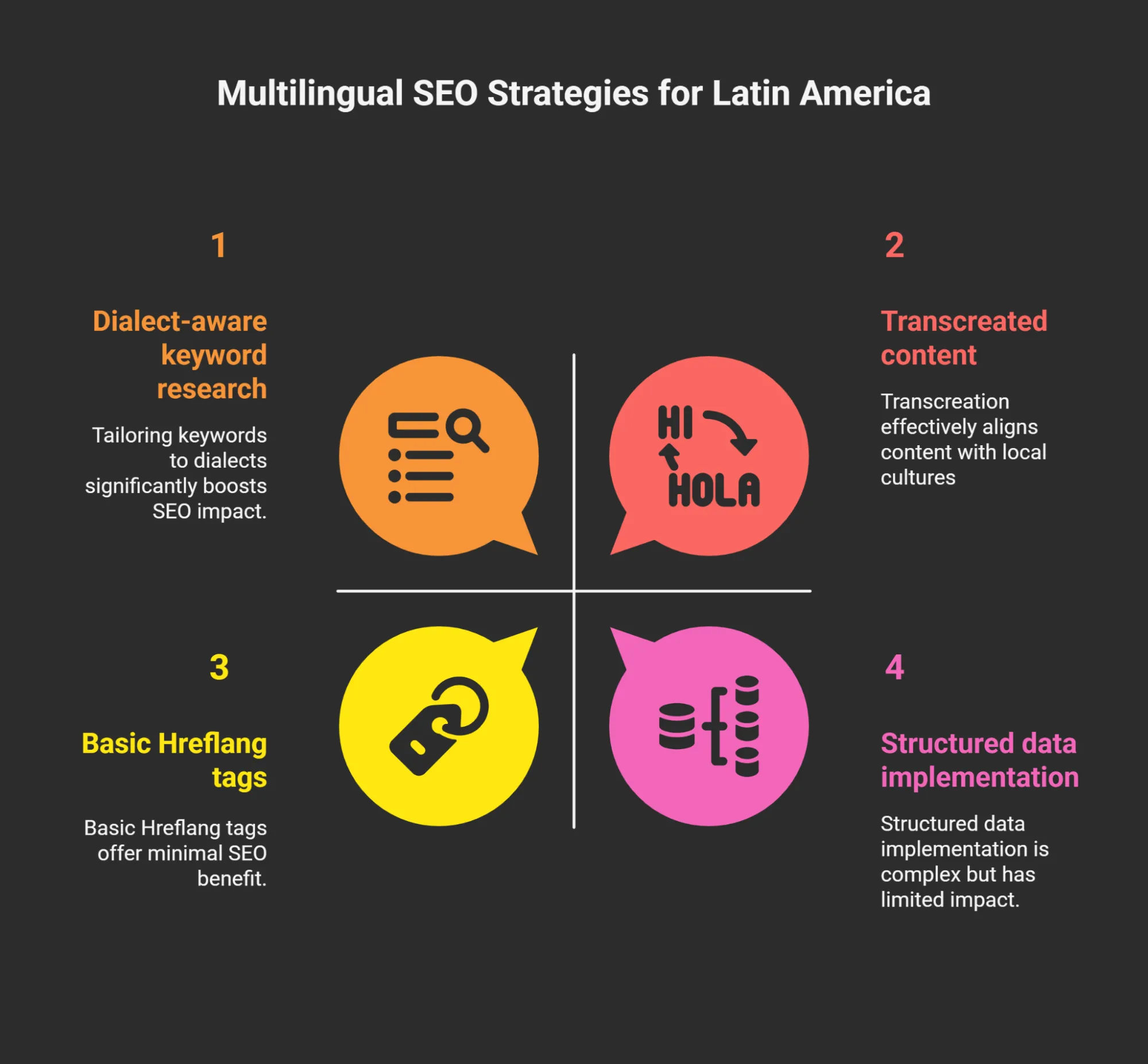
If you want organic traffic to actually convert, multilingual SEO has to be structured properly from the start:
Keyword Research that Respects Dialects
Keyword research for SEO in Latin America has to start with regions and dialects.
Spanish SEO is actually several SEO programs in parallel:
- Mexico: Strong e-commerce and high-intent categories, plus cross-border queries that expect specific shipping and customs rules.
- Colombia and Peru: Mixes of banked and unbanked users that shape how people search for payments, installments, or cash-focused options.
- Argentina and Chile: Sensitivity to price changes, contracts, and B2B services that influence query structure and modifiers.
Brazil sits outside that structure. Portuguese terms, local brands, and the LGPD context require a dedicated Brazilian SEO strategy.
From a process perspective, this means:
- Building keyword lists by country, funnel stage, and job to be done.
- Checking query intent and “false friends” between Spanish and Portuguese.
- Mapping category names, payment vocabulary, and shipping language in each market.
Long tail search is also very relevant. More than 70 percent of searches come from long tail keywords, according to AulaLatina’s SEO overview.
That reinforces the need to build clusters of specific, country-aligned queries instead of relying only on head terms in Spanish or Portuguese.
Pro Tip: If you don’t know how to optimize this by yourself, here are our 11 top keyword research services, including costs, deliverables, and when it makes sense to outsource this part of your SEO work.
Transcreation Instead of Direct Translation
Direct translation often produces content that sounds foreign, even if the grammar is correct.
Transcreation is the better option for Latin America, because it aligns your message with:
- Local expressions and cultural references
- The way users actually describe their problems
- The trust signals they expect to see before converting
Your content strategy stays coherent across markets. The difference is that CTAs, examples, and proof points change just enough to feel native.
This is especially important in content marketing pieces that support search engine optimization, such as how-to articles, comparison pages, and FAQs.
Hreflang and Site Architecture
Hreflang tags allow search engines to send users to the correct language and regional version.
This is crucial in Latin America, especially if you target multiple Spanish-speaking countries as well as Brazil.
You have three mail structural options:
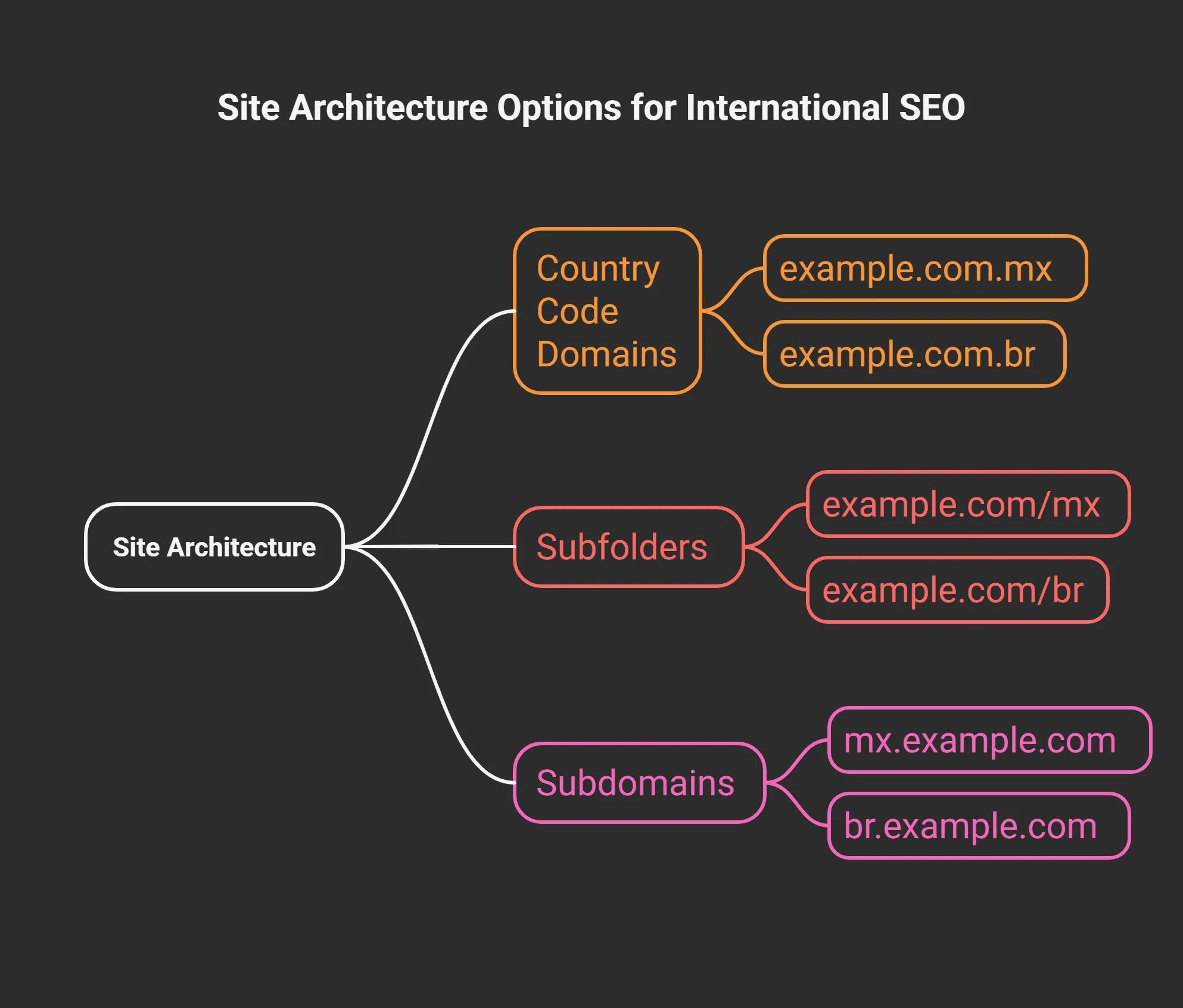
The right choice depends on your current domain strength, internal resources, and long-term internationalization plans.
Many brands select subfolders because they are easier to maintain while still giving country-specific reporting and Hreflang control.
Whatever you choose, the key elements are:
- Correct Hreflang tags for each Spanish country and Brazilian Portuguese, including country and language codes.
- Canonical tags that prevent “Latin America” general pages from competing with country pages.
- Separate XML sitemaps for each country, submitted and monitored in Google Search Console.
A clean international setup helps search engines understand your structure and reduces duplication.
It also makes it easier to analyze organic traffic and SERP performance by country, instead of treating Latin America as a single block.
On-page Signals that Matter
On-page elements are where language and structure become clear signals for both users and search engines.
Each country page should make two things obvious from the first scroll:
- The market it speaks to
- The outcome helps with
To support that, focus on:
- Title tags and meta descriptions that reflect the country context and include phrases like SEO in Latin America or the country name when it helps clarify scope.
- Structured data with the right language codes, currencies, and date formats, so rich results align with local expectations.
- Pricing formats that match local habits, including decimals, currency symbols, and clarity on taxes and fees.
- Author and brand signals that show regional expertise, which becomes essential on financial and health topics.
These on-page choices connect your technical SEO, content strategy, and local search efforts.
They help you win relevant SERP features and strengthen user experience. They also turn multilingual SEO from a translation task into a real growth driver in Latin America.
What Should You Prioritize for SEO in Latin American Countries and Why?
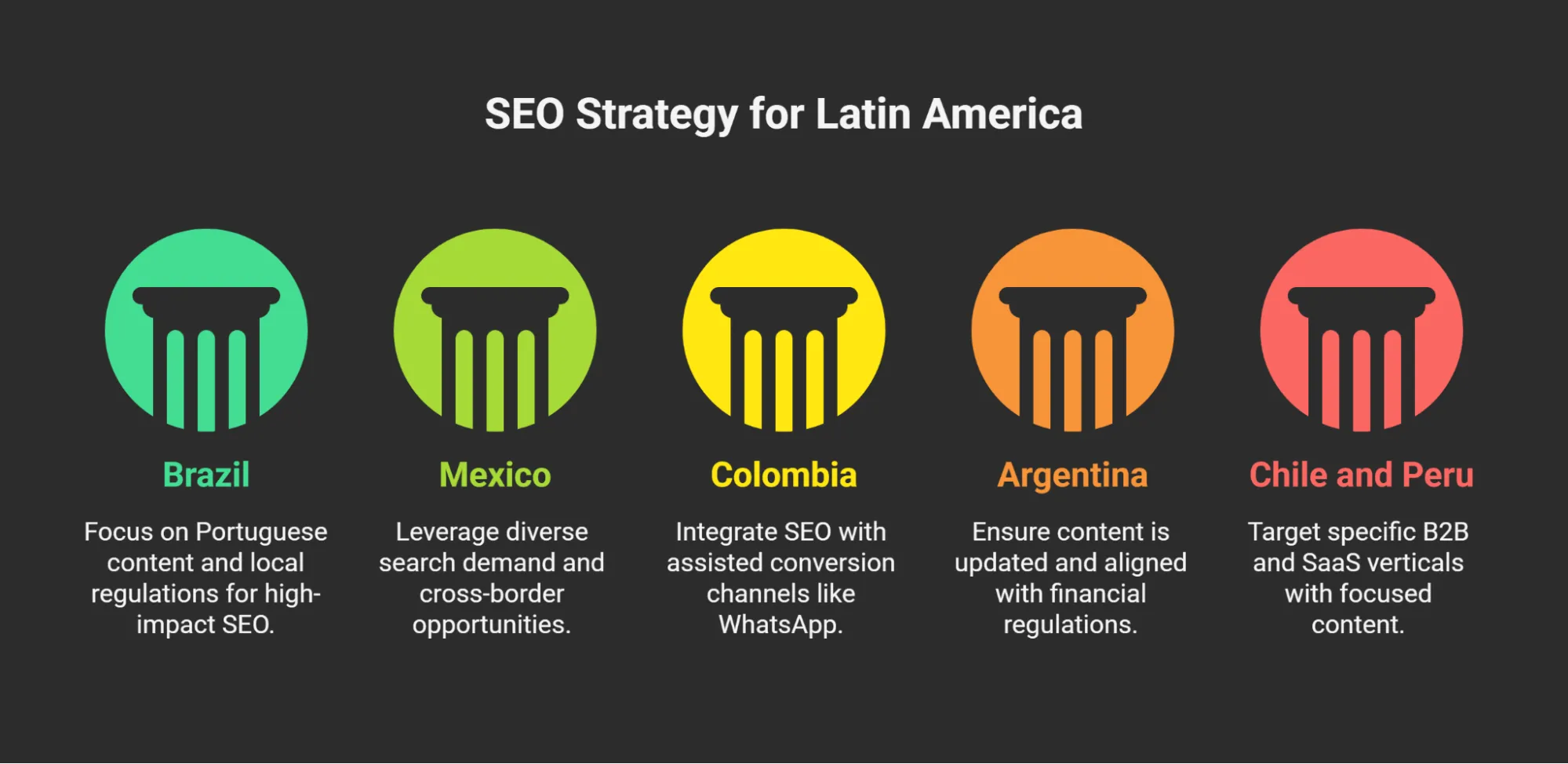
Every country works differently, and it’s important to differentiate them. Let’s see why:
Brazil
In Brazil, you need to operate in Portuguese, account for the influence of major marketplaces, and meet clear expectations around local regulations and payment habits.
If your offer fits the market, and you have teams ready to support Portuguese speakers, SEO in Brazil has the potential to deliver a serious impact.
From a practical standpoint, Brazil is a good choice if:
- You already handle customer support and sales in Portuguese.
- Your product can be sold through local payment methods and billing setups.
- You have clarity on which categories or features resonate locally.
On the SEO side, you need one dedicated plan: separate keyword research, editorial calendar, and technical configuration for all Brazilian pages.
Mexico
Mexico has scale, category diversity, and strong intent in many verticals. There is meaningful search demand in e-commerce, fintech, education, travel, and services.
It is also a natural bridge for cross-border plays, so queries can mix local and international expectations in the same SERP.
This makes Mexico a strong candidate if you want to:
- Test Spanish SEO content that can later inform other markets.
- Validate pricing and positioning for regional offers.
- Use SEO insights to guide paid search and social campaigns.
For your roadmap, Mexico works well early in the sequence, especially if your team already handles Spanish support and has some brand presence in the country.
Colombia
Colombia is a high-opportunity market with very search-driven user behavior.
Buyers look for transparent pricing, clear conditions, and flexible ways to pay, and most paths to purchase involve mobile plus some form of chat or call interaction.
If your sales motion already runs through WhatsApp or equivalent tools, SEO traffic can flow directly into those conversations.
Colombia is a smart move if you:
- Sell products or services that benefit from assisted conversion.
- Have local partners, distributors, or teams on the ground.
- Want to build case studies and proof you can reuse in nearby markets.
SEO work in Colombia tends to reward practical content, strong FAQs, and pages that explain “how this works in Colombia” rather than generic benefits.
Argentina
Argentina is valuable, but it can be unforgiving if you ignore context.
Price changes, currency issues, and regulations make buyers sensitive to outdated information.
That pressure shows up in how people read pricing pages, comparison content, and any copy that talks about long-term commitments.
Argentina makes sense in your priority list if:
- You can update key content frequently.
- Your finance and legal teams are aligned with marketing.
- You are ready to be very clear about validity dates, conditions, and sources.
From an SEO perspective, Argentina rewards content that is explicit about timing and data.
Chile and Peru
Chile and Peru are strong candidates for focused, high-value programs rather than broad coverage.
Demand tends to be more concentrated in specific verticals, especially in B2B and SaaS segments. That plays well with brands that already work account-based or rely on partners and resellers.
These markets are good early bets if:
- You sell solutions that need multiple stakeholders to say yes.
- Events, associations, and industry media matter in your pipeline.
- You can support longer sales cycles with content and sales enablement.
In Chile and Peru, SEO works best when it is tightly aligned with your go-to-market strategy.
Target the exact queries that match your ICP and use content as support material for sales conversations.
Pro tip: Our SEO management services centralize keyword research, content, and reporting for every Latin American market you care about.
SEO in Latin America: Common Pitfalls and Easy Wins
Your SEO in Latin America can look “fine” on paper and still underperform. In many cases, the problem is not demand. It is how the work is structured.
Let’s see why:

Common Pitfalls
These issues show up again and again:
- Treating the region as one market instead of planning by country.
- Translating content literally instead of doing real transcreation.
- Broken or missing Hreflang, weak international setup.
- Heavy images, video, and JS on mid-range mobile devices.
- Cloned content across countries with minimal changes.
- Ignoring local payment habits, pricing formats, and currency displays.
- Generic author bios, thin category/location pages, weak local proof.
- Inconsistent NAP data and weak Google Business Profile setups.
- Buying links or relying on private blog networks.
- One GA4 / Search Console setup for the whole region.
- Consent, PR, and messaging flows (WhatsApp) are not aligned with how people actually buy.
If several of these sound familiar, the issue is structure and not the market.
Easy Wins
You can still move fast with targeted changes:
- Add country-specific FAQs, pricing formats, and units to key pages.
- Publish localized proof: testimonials, case studies, and press logos per country.
- Fix Hreflang, canonicals, and add country sitemaps in Search Console.
- Compress media, enable lazy loading, and use a regional CDN.
- Standardize GA4 events, build country dashboards, and enforce UTMs.
- Tighten Google Business Profile and interlink country pillars, supporting content, and store/location pages.
These actions give you real momentum while you build a deeper SEO strategy for Latin America.
Grow Your SEO in Latin America
SEO in Latin America pays off when you approach it country by country. Each market has its own search patterns, payment habits, regulations, and language nuances.
The brands that win are the ones that build dedicated playbooks instead of treating the region as one audience.
Once the foundations are in place, the work becomes a steady loop: refining keyword clusters, expanding local content hubs, strengthening authority with regional media, and partnering with trusted publishers or communities in each country. Over time, this creates the kind of local credibility that generic content can never match.
If you want support on this, Blue Things can help you to structure your country rollouts and align content operations with real demand.
Get in touch, and we’ll help you build a practical, country-specific plan for your next stage in Latin America.
Frequently Asked Questions
Why does seo matter in Latin America?
Because a big share of buying decisions still starts on Google. If you are not visible there, marketplaces, competitors, and aggregators own the business and attract the demand you could convert.
What are the biggest SEO challenges in Latin America?
Treating the region as one market is the main problem: generic Spanish, weak Brazilian coverage, and keywords that ignore country reality. The second issue is technical: slow, JS-heavy sites on mid-range mobile devices with uneven connections.
How can we improve our SEO for Latin America?
Fix your international setup first: clear URLs per country, correct Hreflang, clean sitemaps, and better Core Web Vitals on mobile. Then build country-level keyword maps, publish localized content tied to real conversions, and review performance by market every month.
How does language variety change SEO?
It changes which queries matter, how copy is read, and how many users trust you. You need transcreation by country, not one generic “LATAM Spanish” plus a rushed Portuguese version.
How do I set up hreflang for Spanish and Brazilian Portuguese?
Define your structure (subfolders, subdomains, or country domains), assign one canonical URL per country–language version, and then implement Hreflang tags with the right codes (es-MX, es-CO, es-AR, es-CL, es-PE, pt-BR). Validate everything in XML sitemaps and Google Search Console, so users reach the correct version.
Do I need separate GA4 and search consoles for each country?
You need clean country-level views, even if you reuse the same accounts. In GA4, set up tracking and dashboards that break results down by market; in Search Console, use properties per domain, subdomain, or key subfolder so you can see how each country performs on its own.