
In 2026, you absolutely need to leverage voice search into your SEO strategy. Today, there are approximately 8.4 billion voice assistant devices in use globally, already outnumbering the world’s population.
Plus, over 27% of people use voice search already.
Despite this massive shift in how users interact with this technology, only about 13 % of marketers actively optimize for voice search. That discrepancy reveals a massive opportunity for brands willing to rethink how they approach search engine visibility and conversational search.
Ranking for voice is different from traditional SEO. It requires a shift in how you think about content, keywords, and what "ranking" even means when there's only one answer spoken aloud.
This guide breaks down exactly how to do it.
TL;DR
- Voice search SEO requires structuring content around conversational questions, not just the traditional keywords.
- Winning voice visibility depends heavily on featured snippets, schema markup, and clear answer formatting.
- Natural language writing and intent-focused headings help voice assistants interpret and select your content.
- Local optimization, mobile performance, and fast load times are critical for high-intent voice queries.
- Topical authority and interconnected content clusters increase the likelihood of being chosen as the spoken answer.
P.S. Struggling to turn voice search into a reliable growth channel? At Bluethings, our specialists combine technical SEO, conversational content, and AI-ready optimization to help your brand rank, engage, and convert through voice.
Why Voice Search Demands a Different Strategy
Voice queries look different than typed searches. They are longer and more conversational compared to the fragmented keywords that once ruled SEO.
Think about how you use voice search.
You're driving and ask your phone: "Where can I get pizza delivered right now?" You don't ask "pizza near me." That gap between how people speak and how they type is what separates voice SEO from everything you already know.
This shift toward longer, natural language patterns is driven by the rise of voice assistants like Google Assistant, Amazon Alexa, and Siri, all powered by natural language processing that seeks to understand context and user intent, not just keywords.
How to Rank for Conversational Queries
Winning voice search comes down to how well your content matches the way people actually speak. The tactics below cover everything from content structure to building the kind of brand authority that AI systems cite.
1. Build Question-Based Content
Voice queries almost always begin with a question: who, what, where, when, why, or how. To capture these, you must build content that directly answers what users are asking.
And to build content that matches those queries, start with question-based keyword research.
Use tools like AnswerThePublic, AlsoAsked, Google's "People Also Ask" boxes, and SEMrush's Questions filter. It will help you understand your target audience's search behavior and map the exact phrasing they use.
Pro tip: Think of how they'd ask about their problem, not how you’d describe your product or service.

2. Optimize for Featured Snippets
Featured snippets, the concise answer boxes that appear at the top of Google results, are the primary source for voice responses. Backlinko found that around 40.7% of voice answers came from featured snippets, making them the single most reliable path to voice search visibility.
The problem is that most brands treat featured snippets as a byproduct of good writing. They're not. They require deliberate structural decisions at the content level.
To consistently win them:
- Answer first, always: Place a direct 40–60 word answer at the very top of the section before any context.
- Phrase your H2s and H3s as the question: "What is featured snippet optimization?" is likely to outperform "Featured Snippet Overview" every time. The heading signals to Google that this section is the answer to a specific query.
- Target one question per page or section: Trying to rank for five related questions in a single block dilutes your ability to win any of them.
- Use standalone answer blocks: Don't bury the answer inside a paragraph. Put it in its own block, then elaborate below for human readers who keep reading.
- Use bullet points and numbered lists: Google frequently pulls structured lists directly into snippets. If your answer has steps or components, format it as a list, not a paragraph.
- Build FAQ sections with extraction in mind: Each Q&A pair should be self-contained. Voice assistants need clean, extractable content, not answers that only make sense with the surrounding context.
Quick note: Google is increasingly replacing traditional snippets with AI Overviews for many informational queries. You've already seen these in your own searches.
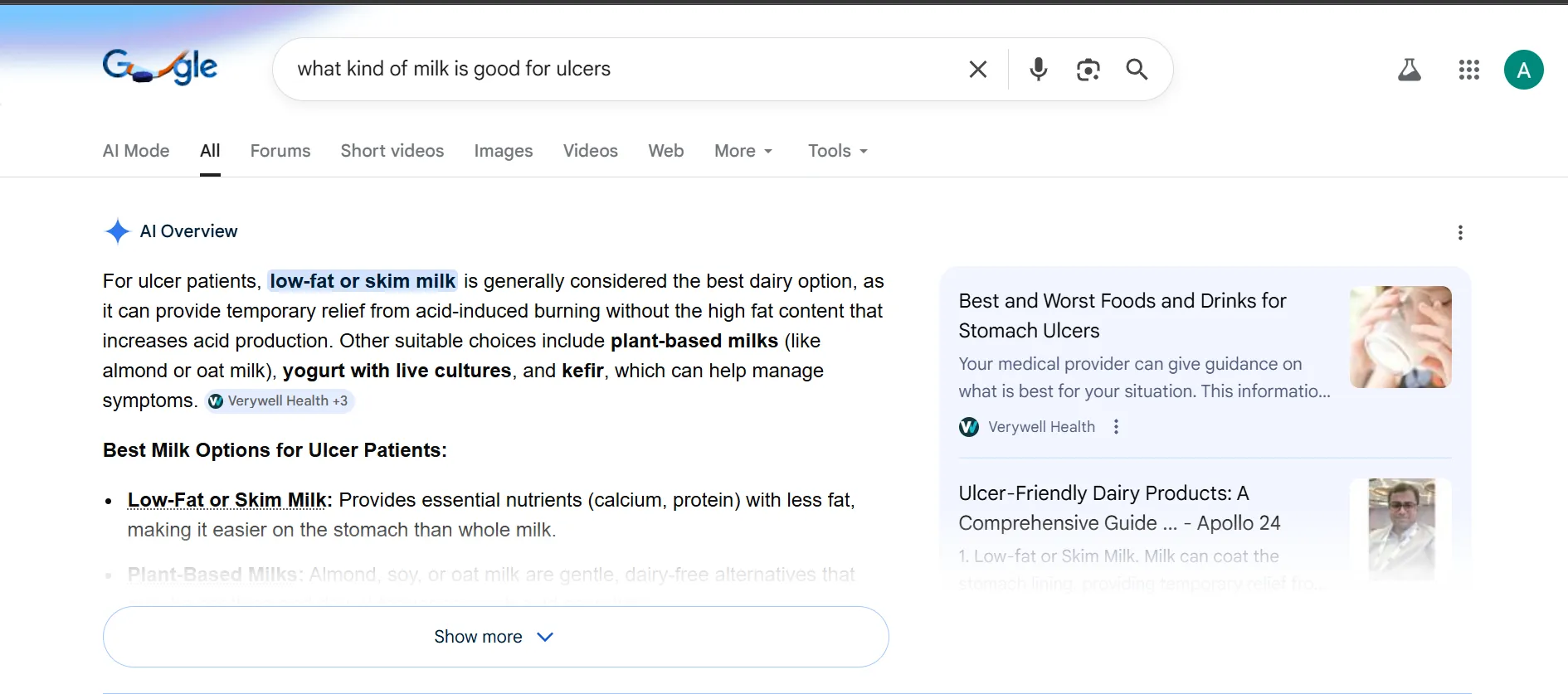
The good news is that the content structure that wins a featured snippet is exactly what Google pulls from when generating AI Overview responses.
What to read next: To understand how AI Overviews are reshaping search visibility and what it means for your content strategy, read our full breakdown of AEO vs SEO.
3. Use Natural Language in Content Headings
Voice searches happen in natural conversational language. The average voice query contains about 29 words, compared to the short, fragmented phrases typical of typed search.
This difference matters more than most brands realize. If your headings read as keyword strings and your paragraphs sound like product documentation, voice assistants will skip your content entirely. It doesn’t matter if it's accurate.
Essentially, write the way a knowledgeable person actually speaks. You can write conversationally in the following ways:
- Keep sentences simple and direct: Avoid unnecessary jargon or overly technical phrasing.
- Use lots of pronouns (I, we, they, us): These make your content read and sound more natural.
- Use active voice: "Google pulls answers from structured content" lands better than "answers are pulled by Google from structured content."
Bonus tip: If you read your content aloud and it sounds like a brochure, rewrite it until it sounds like a conversation.
The irony is that the writing that wins voice search is also the style that keeps human readers engaged. Adjust your tone to be as approachable as possible, but don’t go overboard and write in a way that your content has little to no value.
4. Enhance Local SEO for Voice Searches
Voice users tend to ask location‑specific questions using “near me” or direct place names. As you can see below, over 50% of voice queries are about getting directions.
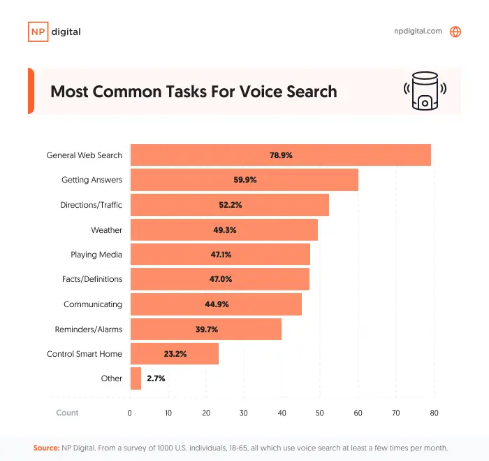
For businesses, this means you must optimize local signals:
- Complete your Google Business Profile with accurate address, contact, hours, and NAP (Name, Address, Phone) information.
- Monitor and respond to reviews, as these contribute to local trust signals.
- Ensure your listings are consistent across major platforms like Yelp, Google Maps, and Apple Maps.
- Use local keywords.
Optimizing your actual website for local voice-based searches is equally vital. Create dedicated, location‑specific landing pages that weave in neighborhood or city names naturally within conversational search phrases.
A good example of this done right: Texas Criminal Defense Group runs separate pages for every city they serve across Texas. Each page targets local search phrases specific to that area and doesn’t use generic terms.

Additionally, using schema markup such as LocalBusiness, FAQ, and Review schema ensures structured data about your business is easily extracted by voice systems.
Tools like Yext help you manage listing consistency across platforms. That’s very important because a single NAP inconsistency across directories can undermine your local voice visibility.
5. Prioritize Page Speed and Mobile Performance
About 58% of voice queries happen on mobile phones. This makes mobile optimization and page speed essential components of your voice SEO.
Search engines also use mobile‑first indexing, meaning they evaluate your mobile experience first when determining rankings. Pages that appear as voice search answers load in about 4.6 seconds on average, roughly 52% faster than typical pages.
To improve your page speed:
- Compress images before uploading using tools like TinyPNG.
- Enable browser caching so returning visitors don't reload the full page every time.
- Eliminate render-blocking JavaScript that delays how quickly your page becomes usable.
- Use responsive design with tap-friendly UI elements built for mobile screens.
Pro tip: Use tools like Google’s PageSpeed Insights to evaluate your site speed on mobile and make improvements.
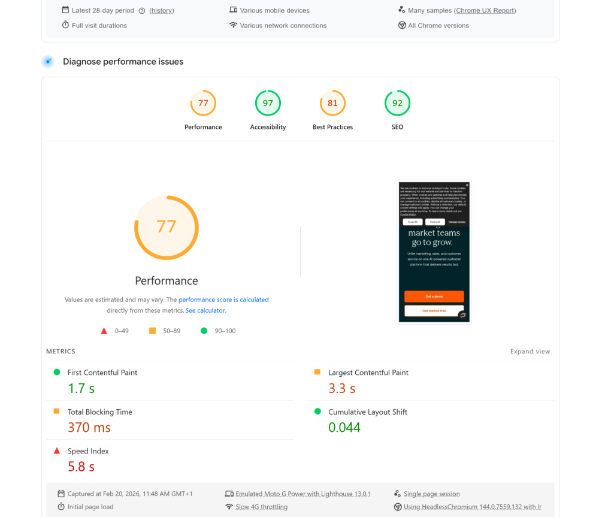
You don’t have to make all the suggested changes. But focus on getting the Speed Index below two seconds.
6. Implement Conversational Schema Markup
Schema markup, also called structured data, is a semantic code that you add to your website’s HTML to help search engines understand what your content means.
As AI assistants like ChatGPT and Perplexity increasingly use structured data to verify facts and cite sources, schema markup is now doing double duty across traditional and AI-driven search.
Key schema types for voice search include:
- QAPage Schema: Use this for single, high-value questions with deep, detailed answers. It sends E-E-A-T signals that tell AI tools this page is the authoritative answer to a specific query.
- FAQ Schema: Best for pages with multiple short Q&A pairs, think 10 or more questions with concise, one-to-two sentence answers. Traditional FAQ sections at the bottom of a page are the ideal use case.
- HowTo Schema: Ideal for step-by-step instructional content. Voice assistants frequently pull HowTo answers for "how do I" queries.
- LocalBusiness Schema Markup: Non-negotiable for any brand with a physical location or service area.
- Speakable Schema: Explicitly marks sections of your content as suitable for text-to-speech.
- Product and Review Schema: For "best" and comparison queries, review schema helps deliver verdict-style answers that voice assistants prefer.
Tools like Google's Structured Data Markup Helper and plugins like Schema Pro and All in One SEO make implementation more manageable. After adding markup, validate it with Google's Rich Results Test before going live.
Keep in mind that schema doesn't directly boost rankings on its own. But it ensures your best conversational content is understood correctly by search engines and AI platforms, which is the prerequisite for being cited in voice responses at all.
7. Optimize for Entity Clarity (Not Just Keywords)
Voice systems don't just match keywords; they resolve entities. An entity is a distinct, well-defined thing: a brand, a product, a person, a place.
When a voice assistant answers a question about your brand or service, it's drawing on how clearly that entity is defined across the web and whether it trusts it as a source.
To build that clarity for your brand:
- Use consistent brand naming everywhere, from your site and social profiles to directories and press mentions.
- Implement Organization and AboutPage schema. These explicitly tell search engines who you are and what you do.
- Build a clear "What is [Brand]?" section. A well-structured About page that directly answers this question strengthens your knowledge panel signals.
- Earn authoritative mentions in industry publications, Wikipedia, and academic or government domains.
- Claim and complete your Knowledge Panel via Google Search Console. Every field should be accurate and complete.
Take Hurom, the premium cold-press juicer brand, for example.
When we at Bluethings partnered with them, the goal wasn't just rankings. We focused on building Hurom's authority as the definitive entity in the slow juicer space across both the US and Canadian markets.
That meant producing expertise-driven content that educated the market on slow juicing, earning 113 links on medium to high-authority health and lifestyle websites, and strengthening Hurom's presence across the web.

The result was a leap from 816 to 1,300 keywords captured in featured snippets in just five months, an 88% increase in organic sessions year over year, and 847% growth in organic shopping.
When search engines and AI systems encounter a brand that is consistently mentioned, well-linked, and clearly defined across authoritative sources, they trust it. That trust is what gets you cited.
8. Map Conversational Intent SEO Topic Clusters
Voice queries don't happen in isolation. When a user asks: "What is performance marketing?" They are more likely to follow up with: "Is performance marketing worth it for a B2B brand?" Each question flows from the last, and if your content only answers one of them, you lose the thread of that conversation entirely.
Google's "messy middle" research indicates that consumers don't progress in a linear fashion from awareness to purchase. They explore options, evaluate them, then explore again, across multiple searches and touchpoints, before committing. Voice removes the friction of retyping between those loops, which makes query chaining even more common.
If you only optimize for the entry-point question, you're winning one moment in a conversation that could have been yours, start to finish.
Here’s how to build for the whole thread:
- Map question clusters around each core topic
- Interlink them logically so users and crawlers follow the thread
- Anticipate follow-up questions and build layered answer depth
- Cover objections and edge cases, too
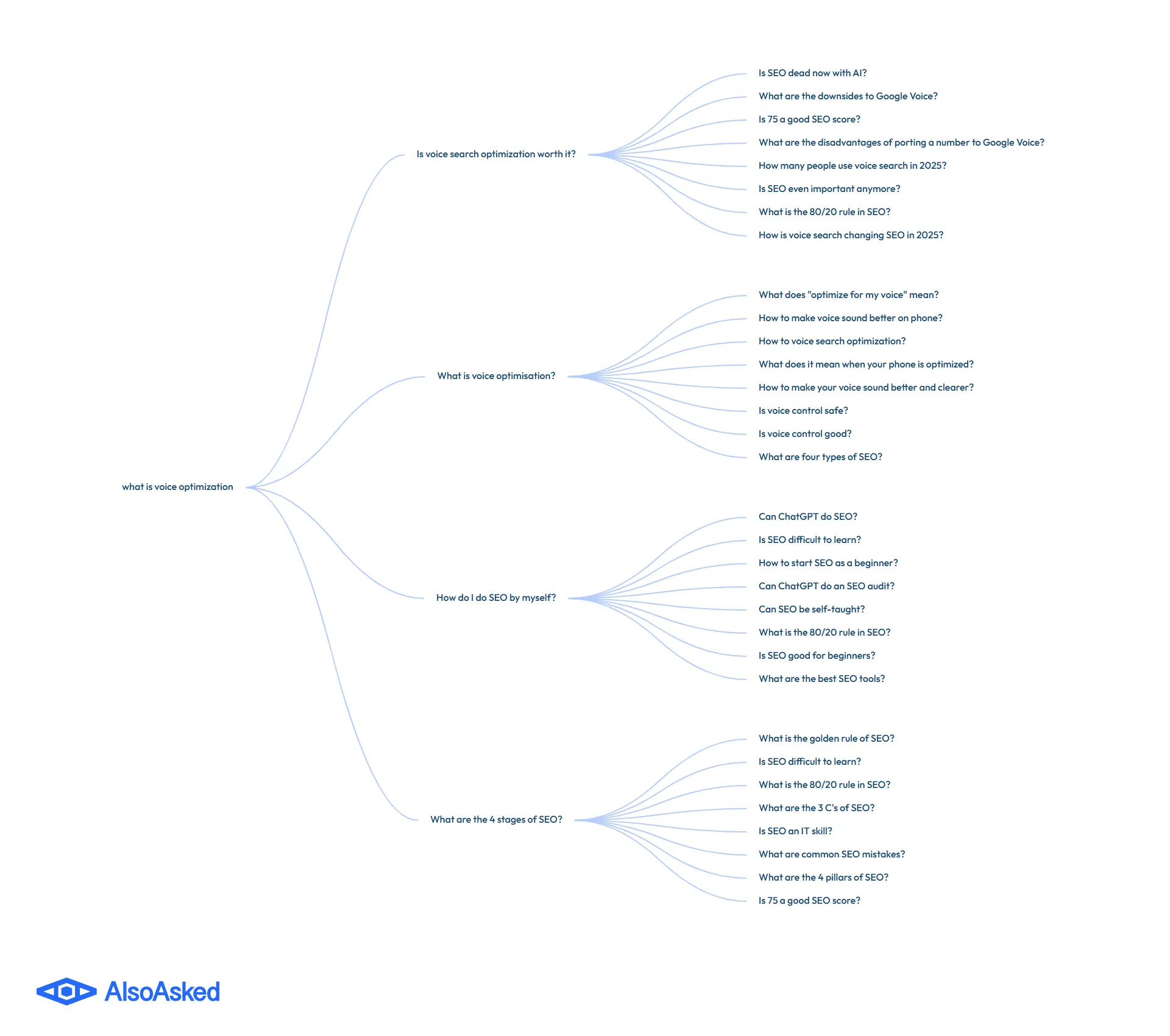
Pro tip: Use AlsoAsked to map the full question chain around any topic. It pulls directly from Google's People Also Ask data and shows you which conversational intents to prioritize.
Here's what that looks like for "what is voice optimization":
9. Optimize for “Best” and Comparison Queries
Many voice search users ask evaluative questions that go beyond basic facts. “What’s the best project management software for small teams?” or “Which is better, X or Y?” are high‑intent conversational queries.
Data shows that 51% of online shoppers use voice assistants to research products before buying. These aren't passive browsers. By the time someone asks a "best" or comparison question, they're already deep in the decision process.
To structure your content for these queries:
- Lead with a direct recommendation. State who something is best for upfront, before any elaboration.
- Build comparison tables around the decision factors your audience actually cares about.
- Include explicit pros and cons sections.
- Add structured review schema so voice systems can surface verdict-style answers and star ratings.
Pro tip: The more specific your comparison, the faster you win the snippet. A page dedicated to "Klaviyo vs Mailchimp for e-commerce brands" will outrank a generic roundup for that specific voice query.
10. Strengthen Topical Authority Across the Cluster
Featured snippets can be won page by page. But sustained conversational visibility increasingly favors domain-level authority.
Search engines and AI systems assess trust at the site level, not just the page level. Build topical authority across the cluster by:
- Covering your topic comprehensively; leaving gaps invites competitors to fill them
- Reducing or consolidating thin content that dilutes authority signals
- Linking related questions internally so your site reads as a coherent knowledge base
- Updating key pages regularly to signal freshness
Start with high-level pillar pages that define a subject (e.g., Voice Search Optimization in 2026) and link to supporting pages targeting narrower conversational queries (e.g., Mobile-first indexing and voice SEO).
Here's what that content structure looks like in practice:
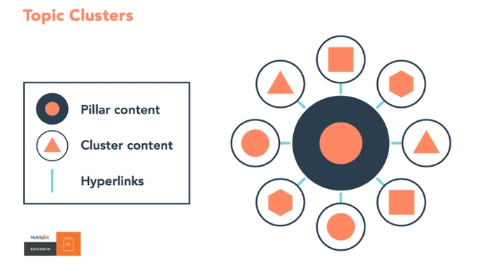
This reinforces your authority while signaling to search engines and voice assistants that your site is the go-to resource on the subject.
Plus, you're increasing your chances of ranking your content in AI-generated answers.
How to Measure Voice Search Performance
Measuring success in voice search differs significantly from a traditional SEO strategy. Many conversational queries lead to zero-click journeys, where users get answers directly from voice assistants without visiting your website.
This means you need to track indirect signals and optimize based on the visibility of your content in voice-driven contexts.
Google Search Console is a good starting point. Use it to monitor long-tail and question-based queries.
SEMrush and Ahrefs let you track which of your keywords are appearing in featured snippets and People Also Ask boxes: two of the most reliable proxies for voice visibility.
For local and transactional voice searches, track Google Business Profile insights directly. Clicks for directions, calls, and website visits are reliable indicators of local intent queries converting into action.
Don't treat this as a one-off effort. Keep auditing existing content for conversational gaps, research new question-based keywords regularly, and work them into new content as you publish.
Turn Conversational Search into a Growth Channel with Bluethings
Voice search marketing is an opportunity most brands are still leaving on the table. The tactics in this guide work, but they require consistent execution that compounds over time: content built around real conversational queries, technical foundations that pass voice search filters, and topical authority depth.
At Bluethings, we blend LLM SEO, structured schema markup, and conversational content strategy to help brands rank for voice search and conversational queries.
We also optimize Google Business Profile, local listings, and mobile experience to turn voice visibility into tangible growth.
With $1.5 million in revenue generated for our clients, we understand what it takes to rank where it counts.
Ready to capture high‑intent voice traffic before your competitors? Get in touch with our team to get started.
FAQs
What is voice search optimization?
Voice search optimization is the process of structuring content and technical elements so that AI voice assistants like Alexa, Google Assistant, and Siri (across devices such as Amazon Echo and Google Nest) can find, interpret, and read answers aloud to conversational queries. It focuses on user intent, question-based keywords, and structured data, going beyond traditional SEO keywords.
What types of keywords work best for voice search?
Question-based, conversational long-tail keywords dominate voice search optimization. These typically start with who, what, where, when, why, or how, reflecting semantic search and user intent. Short text-based search terms don’t do this. Tools like AnswerThePublic and SEMrush’s Questions filter help uncover these spoken queries.
Does voice search matter for B2B brands?
Yes. Even in B2B, decision-makers increasingly use voice assistants on mobile phones or smart speakers for research. Optimizing for conversational search can capture high-intent leads who are actively seeking solutions or comparing vendors.
Can Bluethings help optimize my site for voice search?
Yes. Bluethings combines technical SEO, structured schema markup, AI-ready content strategies, and local optimization to help brands rank for voice search, capture high-intent users, and improve visibility on search engines and voice-enabled devices.
Appendix: Research Sources
- https://www.twinstrata.com/voice-search-statistics/
- https://searchendurance.com/voice-search-statistics/
- https://seoprofy.com/blog/seo-statistics/
- https://backlinko.com/voice-search-seo-study
- https://aicurator.io/voice-search-statistics/
- https://www.huddlecreative.com/blog/voice-search-for-brands-trends-statistics
- https://www.demandsage.com/voice-search-statistics/
- https://marketingltb.com/blog/statistics/voice-search-statistics/
- https://www.citedagency.ai/blog/voice-search-optimization
- https://www.thinkwithgoogle.com/intl/en-emea/consumer-insights/consumer-journey/the-consumer-decision-making-process/
- https://www.invoca.com/blog/voice-search-stats-marketers