Most SEO advice revolves around fixing your titles, building more content and links, or improving your Core Web Vitals.
And sure, that matters.
But brands that consistently show up first in search tend to have a strong real-world presence too.
When people hear about your brand at a conference, they search for it. When a local paper covers your story, you get a link. When a customer has a great experience in person, they leave a review.
Search engines observe all of it.
This guide breaks down offline SEO as a system, so you can start doing it, too.
Let’s get into it.
What Is Offline SEO?
Offline SEO refers to real-world actions that create online signals search engines can observe and measure.
Here’s how these specific offline actions can lead to measurable digital outputs:
- Offline exposure increases brand awareness.
- Awareness drives branded searches.
- Branded searches signal genuine demand to search engines.
- Demand leads to higher click-through rates on your results.
- Visibility leads to more mentions, editorial links, and reviews over time.
- Those signals build domain authority and trust.
- Trust improves performance on non-branded, competitive queries.
- You get more online exposure, which increases your brand awareness even more.
So, the cycle starts repeating itself.
What Offline SEO Is Not
A few things are worth clearing up before going further. Offline SEO is not:
- A replacement for technical and on-page work. A slow site with broken tracking won’t be saved by a great PR campaign. Offline SEO amplifies a solid foundation, but it doesn’t substitute for one.
- It’s not brand marketing with no measurement. “Get your name out there” is not a strategy. Offline SEO is only useful if you can tie activity to observable signals and track them over time.
- It’s not just local SEO. There’s real overlap, especially for service businesses. But offline SEO applies just as much to B2B brands, e-commerce, and national players as it does to local ones. Plus, local SEO is mostly done online, through tactics like using Google Maps or building local content.
Common Offline SEO Examples
To make it concrete, here’s what offline SEO looks like in practice:
- Local and industry PR that earns coverage and links
- Speaking at events or running workshops that drive branded searches
- Sponsorships that include an online listing or mention
- Community involvement that gets picked up by local publications
- Partnerships that generate referral traffic and co-branded content
- In-person customer experience that drives reviews and word of mouth
None of these ideas is new. Marketers have been using them for ages.
What makes them offline SEO is the intent to create trackable online signals and the systems you put in place to measure them.
A conference like Semrush Spotlight Conference is a clean example of offline SEO at scale. The event itself happens in the real world, with marketers attending sessions, meeting speakers like Lily Ray or Kevin Indig, and engaging directly with the brand.
But the real impact shows up afterward, when that experience translates into digital activity.
Attendees go home and publish recaps, share insights on LinkedIn, reference the event in newsletters, and link back to it in their own content.
Here’s a LinkedIn post about it:
And a blog post summarizing insights from four keynote speakers:
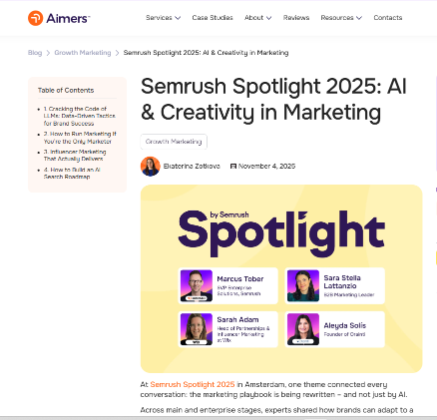
That creates a surge of branded searches, mentions, and backlinks, along with a broader association between Semrush and SEO expertise.
Where Offline SEO Has The Most Impact
The effect is strongest in situations where trust and recognition are already part of how buying decisions get made:
- High-competition niches where technical and content factors are already optimized across the board
- Local service businesses where community presence is a genuine trust signal
- B2B brands where reputation precedes the search; here, recommendations are most likely to trigger a lookup
- New entrants with no existing domain authority trying to compete against established players
Which Offline Signals Show Up Online And Are Worth Tracking?
Offline activity only counts as SEO if it produces something observable. The signals below are what you’re actually trying to move and what you should be monitoring before, during, and after any offline campaign.
Brand Demand Signals
These are the most direct indicators that offline exposure is working:
- Branded search volume: People searching your brand name, tracked in Google Search Console.
- Brand + category queries: searches like “Bluethings SEO agency” that indicate consideration.
- Returning visitors: A rising share of return traffic suggests brand recall is building.
- Direct traffic trends: These are useful as a secondary signal, but interpret carefully; direct traffic attribution is notoriously messy in GA4.
Authority And Coverage Signals
When offline activity earns press, partnerships, or mentions, these are the outputs to track:
- New referring domains: The number of unique domains linking to you, tracked in Ahrefs or alternatives.
- Unlinked mentions: Press coverage, forum references, and community posts that name your brand without linking. We use tools like Ahrefs Content Explorer or Google Alerts to surface these.
- Referral traffic: Direct visits from coverage and partner placements, segmented in GA4.
Reputation And Local Trust Signals
Particularly relevant for service businesses and multi-location brands, but worth tracking regardless:
- Review volume and average rating: Monitored across Google and whichever niche platforms matter in your category.
- Review velocity: The rate at which new reviews are coming in; a spike after an offline campaign is a clear signal.
- Google Business Profile actions: These include calls, direction requests, and website clicks from your GBP listing.
Tracking all of these in parallel gives you a much clearer picture than rankings alone. Rankings are a lagging output. These signals are what move first.
Best Offline SEO Tactics For 2026
Now that you know what offline SEO is, let’s see the right tactics to use in 2026.
1. PR And Media Coverage
Earned media is one of the few offline tactics that produces a direct, measurable online output: an indexed page on an authoritative domain that references your brand and even links to it.
The coverage types we advise you to prioritize include:
- Local news and business journals
- Trade publications in your category
- Podcasts with published, indexed show notes
- Newsletters with online archives
What these have in common is that the content gets indexed. That means Google can observe the mention, and readers can click through to you.
A study by Moz found that linked mentions from authoritative domains remain among the strongest signals in Google’s ranking algorithm. PR is one of the most reliable ways to earn them at scale.
The PR angles that consistently earn pickup:
- Original data from your own business (survey results, internal trends, anonymized client data)
- “How we solved X” stories with concrete, verifiable proof
- Local impact initiatives with a tangible community outcome
- Expert commentary with a clear, defensible point of view
To turn coverage into SEO value, make yourself easy to cite. Build a simple press kit: founder bio, brand boilerplate, high-resolution logo, and a canonical URL. If you don't have a polished logo yet, a logo generator can produce a clean, high-resolution version quickly so your press kit looks professional from day one. This removes friction for journalists and increases the likelihood of a link appearing in the final piece.
For example, when Patagonia releases environmental impact data tied to its supply chain, it gets picked up by dozens of publications. And each is generating an indexed mention or link without a single dollar spent on traditional link building.
Like so:

2. Speaking And Events
Speaking at industry conferences, running workshops, or appearing on panels puts your brand in front of an audience already primed to search for solutions. The SEO value comes from what happens after the event.
Event organizers frequently publish speaker lists, session recaps, and slide decks online. Those pages generate indexed mentions and inbound links without any additional outreach on your part.
But that only happens if your brand name, title, and URL are clearly provided in your speaker bio.
How to make it work:
- Anchor your talk to a specific query cluster. If you want to rank for “B2B lead generation strategies,” build a talk around that exact subject. The content overlap between your talk and your target keyword is what drives the relevant branded searches afterward.
- Use a consistent title and framing across multiple events. Repetition compounds. A talk that you deliver at three events builds more brand association around that topic you picked than three different talks ever would.
- Give attendees one clear next step. A named resource page, a short URL, or a specific search prompt increases organic traffic.
For instance, Rand Fishkin built significant organic authority for Moz in its early years through consistent speaking at marketing conferences. Each event recap, slide upload on SlideShare, and speaker listing reinforced the same brand signals across dozens of indexed pages.
And those pages still exist today, bringing Rand more notoriety:

3. Sponsorships
Most sponsorships are logo placements. So, if you want to use them for offline SEO, confirm the online deliverables first:
- A listing on the event or organization’s website
- A mention in the organizer’s email newsletter (with an online archive)
- A tagged recap post or co-branded content piece
- A speaker slot or giveaway that generates its own coverage
If none of those are on the table, the sponsorship has limited strategic value beyond raw brand exposure.
Pro tip: Audience overlap matters more than audience size. A $500 sponsorship at a niche industry meetup with 150 people who match your buyer profile will outperform a $5,000 logo on a stadium banner. That’s both in brand recall and in the quality of online signals it generates.
Real example: Mailchimp built early brand authority partly through targeted sponsorships of design and creative community events. And these are audiences that perfectly matched their early user base. The online mentions from those communities were more valuable than any equivalent spend on generic advertising.
4. Strategic Partnerships
Partnerships earn online proof that neither party could generate as easily alone.
The formats that produce the most SEO value:
- Co-hosted events with a published recap page
- Co-branded guides, checklists, or research reports
- Joint webinars with indexed show notes and a dedicated landing page
- Partner directory listings and “recommended vendor” pages
When evaluating a potential partner, filter on four things:
- Do their audience and yours overlap meaningfully?
- Can they publish something indexable as part of the collaboration?
- Is there clean brand alignment with no reputation risk on either side?
- Is there a clear agreement on attribution and links before anything goes live?
The most durable partnerships produce a standalone asset: a joint research report, a co-branded tool, or a published case study. Both parties can promote this independently long after the collaboration ends.
As an example, HubSpot and LinkedIn have co-produced research reports on sales and marketing trends for years. Each report earns coverage, links, and citations from third-party publications, so that’s SEO value that compounds well beyond the initial launch.

5. Community Involvement
Community involvement earns the kind of mentions that are difficult to manufacture even in the best link-building campaigns: organic references in local press, neighborhood forums, association newsletters, and community groups. These signals carry weight precisely because they aren’t paid for or negotiated.
For instance, REI’s ongoing investment in trail maintenance and outdoor access initiatives earns consistent coverage from local outdoor and environmental publications. Each generates brand mentions and links that reinforce their authority in the outdoor category.

What actually works:
- Sponsoring a local initiative with real, visible resources
- Running free educational events for a community group that genuinely needs them
- Supporting a nonprofit with consistent involvement, not a one-time donation
Pro tip: Create one public-facing page on your site that documents this work. It gives journalists and community members somewhere to point when they reference your involvement, and it consolidates the SEO value of inbound mentions into a single destination rather than scattering it across your homepage and social profiles.
6. Review Generation Systems
Reviews are one of the clearest examples of offline experience converting directly into a bigger online presence, particularly for local search. Review quantity, recency, and response rate are explicit factors in local visibility.
If you want to get more reviews, timing is your main ally.
In our experience, the highest review conversion rates come from asking immediately after the “win moment” when the job is finished, the product arrives, or the service is complete. Waiting even 24 hours reduces conversion significantly.
A simple system that works:
- Identify your win moment, meaning the specific point in the customer journey where satisfaction is highest.
- Create a standard ask, which can be in person, by text, or by email; keep it short and direct.
- Route negative feedback internally first. It’s important to give unhappy customers a private channel before they reach a public platform.
- Respond to every review within 48 hours, whether they’re positive or negative; Google weighs response rate, and prospective customers read your replies.
This is a textbook example of offline SEO because the trigger happens in the real world, but the impact shows up in search.

When someone visits Bistrot er Marchese, the experience itself is offline. The food, the service, the atmosphere. But that experience leads them to go online and leave a review on Google or platforms like TripAdvisor. That action creates fresh, user-generated content tied to a real business entity, which search engines can crawl, analyze, and use.
These reviews increase the volume and recency of content associated with the business, reinforce its reputation through ratings and sentiment, and improve engagement signals on its Google Business profile. On top of that, reviews include keywords naturally, which strengthens relevance without any direct optimization.
7. Physical Branding
Think vehicle wraps, business cards, door hangers, wall graphics, uniforms, storefront design, packaging inserts, or even the packaging itself… This kind of physical branding creates repeated real-world impressions that accumulate into brand recall.
We've seen this with SmashBrand and G Fuel partnership, where a consistent packaging and identity system helped transform the brand from a niche gaming supplement into a category leader. The stronger the recall, the more likely consumers are to search for the brand by name.
The SEO mechanism is direct: people who recognize your brand name are more likely to search it, and branded search volume is a demand signal that Google measures.
For this to work, the branding has to be consistent, and the name has to be searchable.
If your van reads “Mike’s Plumbing & HVAC Services LLC” in three fonts across two lines, the recall is weaker, and the search behavior it generates is fragmented.
For e-commerce brands, packaging inserts are an underused conversion tool. A well-designed card inside a shipment (with a clear CTA pointing to a review page, referral program, or piece of content) converts a physical touchpoint into a trackable online action.
Pro tip: Use a short URL or QR code on physical materials that points to a dedicated landing page, not your homepage. That single change turns an otherwise untrackable impression into attributable traffic.
8. Word-Of-Mouth Programs
Organic word of mouth is valuable but unpredictable. A structured program makes it repeatable.
The formats that work:
- Referral programs with clear, simple incentives, where both the referrer and the new customer get something tangible.
- Customer advisory groups are small, engaged communities of your best customers who naturally advocate for your brand.
- Formal advocacy programs are structured frameworks where satisfied customers are equipped with shareable content, referral links, and talking points.
The SEO-specific value comes when those conversations happen in indexed places: a LinkedIn recommendation, a forum thread, a community Slack group that gets crawled, a blog post from a customer sharing their experience.
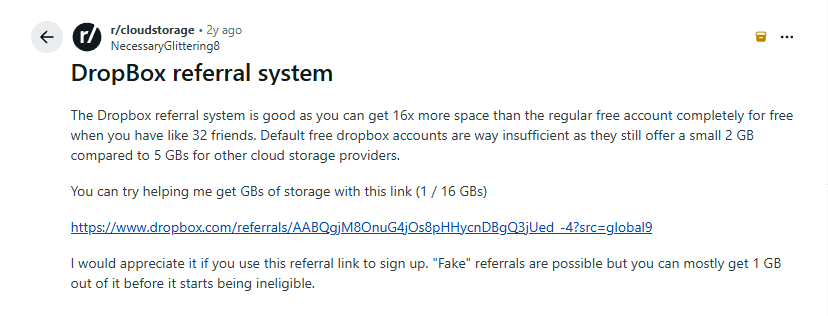
For instance, Dropbox’s referral program (give storage, get storage) turned satisfied users into active recruiters.
Much of the resulting word of mouth happened in tech forums and blogs, generating indexed mentions and organic backlinks that supported their SEO alongside their growth metrics.
Here’s an example from Reddit; it’s two years old already at the time of this writing, and it still produces important SEO signals.
9. Offline Content Distribution
Printed guides, whitepapers, event handouts, and physical resources are underused as SEO tools.
The key is specificity:
- A generic brochure with a homepage URL produces diffuse, unmeasurable traffic
- A printed checklist with a short URL or QR code pointing to a dedicated landing page produces traffic you can attribute, segment, and analyze
To build a distribution piece that converts, we advise you to:
- Lead with genuine utility, like a checklist, a how-to guide, a reference card; something people keep.
- Include one CTA and one URL with one clear next step.
- Use a dedicated landing page, but don’t make that your homepage. Instead, create a page specifically for this specific audience, with relevant content and a clear offer.
- Track it with short URLs, QR codes, and UTM parameters, so you can measure exactly how much search engine traffic each piece drives
Distributing high-quality printed content at events also increases the likelihood that attendees reference it in their own post-event write-ups. Again, this generates unlinked and linked mentions you wouldn’t otherwise earn.
How Do You Build An Offline SEO Campaign That’s Repeatable?
One-off tactics produce one-off results. The brands that see compounding returns from offline search engine optimization treat it as a campaign system. Here’s a simple 6-step framework you can use:
1. Pick one outcome. Define what you’re trying to move: leads, demo requests, foot traffic, branded search volume. Pick one outcome per campaign, and don’t try to do everything at once.
2. Choose one audience segment. Who specifically are you trying to reach? It can be an existing customer base you want referrals from, a new geographic market, or a buyer persona you’re underindexed with. Be specific so you can pick the tactics that make sense.
3. Select one message angle. What’s the single thing you want this audience to associate with your brand after the campaign: a capability, a proof point, a category position? Run that message consistently across every tactic in the campaign.
4. Map tactics to expected signals. Before you launch, write down what you expect each tactic to produce online. A speaking slot should generate a speaker listing and a branded search spike. A press placement should generate a link and referral traffic. If you can’t predict the signal, reconsider the tactic.
5. Launch with tracking assets in place. Dedicated landing pages, short URLs, QR codes, and campaign-specific UTM parameters should all be live before the campaign starts.
6. Review, document, and repeat. At the end of the campaign window, record what moved and what didn’t. That documentation becomes the brief for the next campaign because the big-picture goal is ultimately building a repeatable playbook.
Offline SEO Campaign Examples By Budget
Low budget (under $1,000):
- Build a referral program with a dedicated landing page
- Identify three community partnerships and create a public-facing page documenting the work
- Implement a review generation system tied to your win moment
- Submit to two relevant industry or local awards
Mid budget ($1,000–$10,000):
- Sponsor a niche industry event with online deliverables negotiated in
- Run one PR outreach push with original data or a strong local angle
- Co-host an event with a complementary partner and publish a joint recap
Higher budget ($10,000+):
- Commission original research and run a full PR campaign around it
- Secure speaking slots at two or three conferences with coordinated follow-up content
- Build a co-branded content asset with a high-authority partner and promote it with paid amplification
Conclusion
Offline SEO is real-world credibility converted into online signals. The brands that do it well are building repeatable systems that consistently produce mentions, links, reviews, and branded searches.
So, here’s what we advise:
Pick one tactic from this guide, run it for 60 days with a baseline in place, then measure your results.
If you want support building the strategy, running the campaigns, or setting up the measurement framework, Bluethings can help.
FAQs
How long does it take for offline SEO activity to show up in rankings?
You’ll usually see early signals like branded searches and referral traffic move within a few weeks if you’re tracking things in Google Analytics. Rankings on tougher, non-branded keywords take longer, typically three to six months, because search engine algorithms need consistent proof that demand and engagement are real.
Can offline SEO work for a purely e-commerce brand with no physical location?
Yes, and it often works really well. You don’t need a storefront to run PR, partnerships, packaging inserts, or even influencer marketing. These all plug into an online community and still drive the same thing: people searching for your brand and interacting with it.
Is unlinked press coverage worth pursuing, or do you need the link?
It’s worth it, even without the link. A link helps with authority, sure. But coverage in places like local news outlets still gets your name in front of people. That recognition improves how you perform across search engine result pages over time. If you can get the link later, even better.
How do you prioritize offline SEO tactics with a limited budget?
Start simple. Set up a way to consistently get reviews, partner with one relevant community, and clean up your physical branding. Those three alone can move the needle, especially for things like user engagement and visibility on Google My Business.
Does offline SEO apply to B2B companies that don’t sell to consumers?
Even more so. In B2B, people don’t convert on the first touch. They Google you, check your content, and see if they’ve heard your name before. That’s where things like speaking, press releases, and partnerships all work together to build that familiarity.
How do you handle offline SEO for a brand with multiple locations?
Treat each location like its own mini-market. Run local PR, get reviews per location, and stay active in the local community. At the same time, keep your branding consistent everywhere. Then track what’s happening per location, from reviews to visibility to overall user experience, so you know what’s actually working.